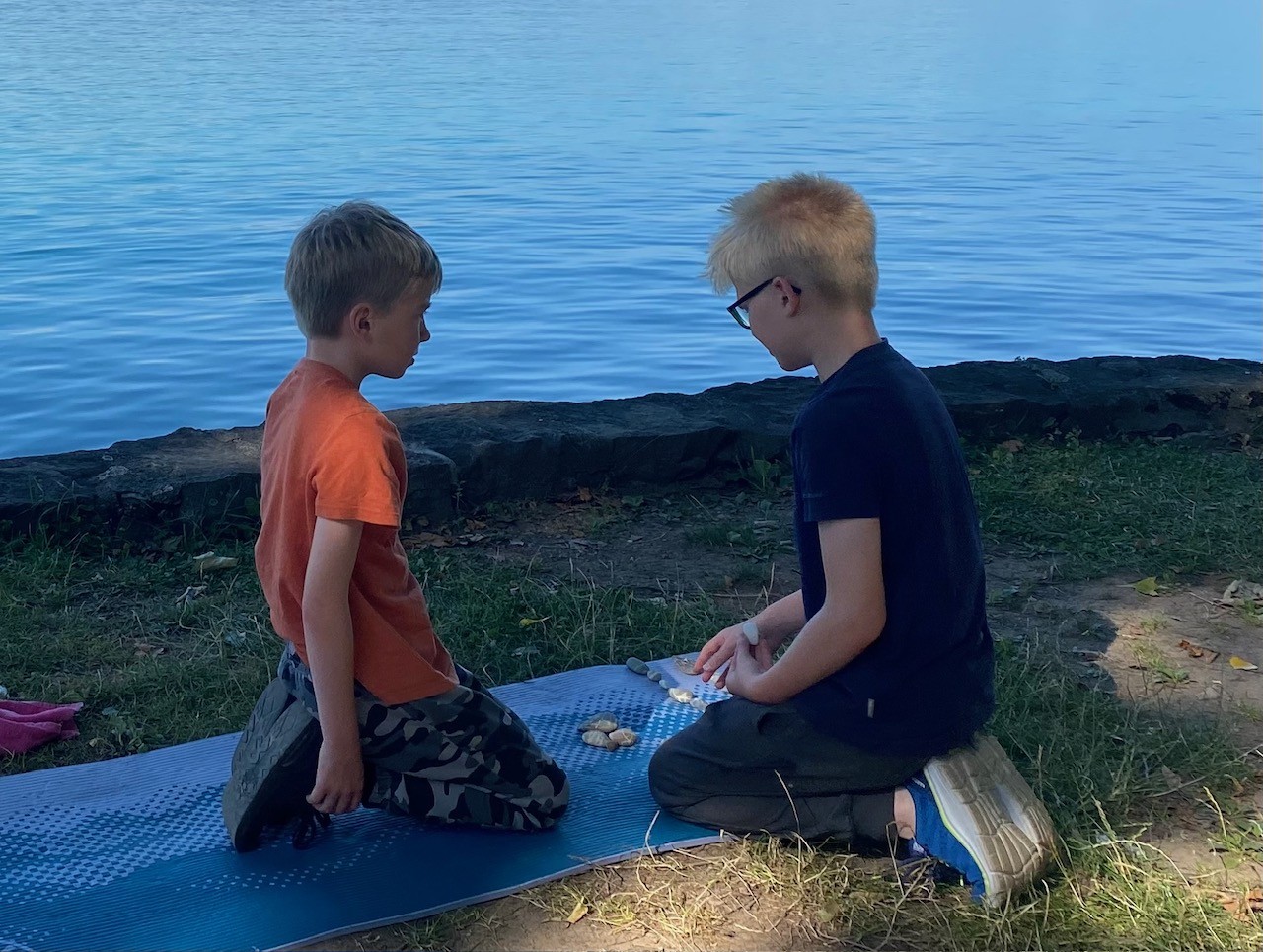
Playing with pebbles (source: author)
What do you remember about lunchtimes at school?
The meals were one thing, but what really stands out in my mind’s eye were the kickarounds. At my primary school in Cardiff, we played on grassy fields which we shared with the ‘Welshies’ – the neighbouring primary school where lessons were taught in Welsh. At secondary school, we played on tarmac, and we were only allowed to play with tiny footballs, but the games were jumpers-for-goalposts affairs, and all were welcome – even me with my awful skills. The games were a welcome break from my studies.
When I do lunchtime break duties at school today, it’s great to see hundreds of pupils still having kickarounds, with a few younger ones playing tig. There’ll also be games of tennis-ball cricket, and on the sidelines a few younger girls will be doing some kind of dance or singing a song that I’ve never heard of.
And my sons’ main talking points after a day of primary school often mention the games they played at break time, in after-school clubs, or in PE. It’s also great to hear about how so much of their learning takes part through the medium of outdoor play – whether that’s chalk-drawn times tables on the tarmac or orienteering with quiz questions at every checkpoint.
Is play being squeezed out of schooling?
But overall, and with some admirable exceptions, play seems to be being squeezed out of schooling, in the name of behaviour management, squeezes on funding and staffing, health and safety concerns, and in some cases owing to the reduction of available green space and even asphalt playgrounds.
Research has highlighted the problems of declining lunchtimes and breaktimes at secondary schools – one of which is the restriction of children’s instinct to play. An older friend of my son reports taking a packed lunch, not because the school meals are bad, but so that in the half an hour allocated to lunchtimes, he can snaffle down half a sandwich and then spend the remaining 25 minutes playing football. A teacher at another school reports that their students barely have any time to step outside and burn off some energy between their rigid ‘family meal’-style lunch and their disciplined but time-consuming queuing system prior to afternoon lessons.
Decline of play outside of school
You may think that such arrangements are fine because children can play outside when they get home. But, in a trend which Jonathan Haidt pointed out started in America, parents and other caregivers have been increasingly reluctant to let their children play outdoors, especially in unstructured, independent play.
Some of this is down to a trend towards directing children towards more organised extra-curricular activities for fear of them missing out on some skill or other. Some of it is due to an exaggerated fear of external dangers such as violent crime. And some of it is due to a well-intentioned but ultimately psychologically harmful desire to protect our children against getting injured.

Jonathan Haidt’s book, The Anxious Generation (source)
In parallel with this trend towards overprotectiveness, Haidt, in his book, ‘The Anxious Generation’, demonstrates that increased use of smartphones and other screen-based activities amongst children since the early 2010s has resulted in fewer opportunities for children to play together, whether indoors or outdoors, and therefore fewer chances for them to learn how to socialise and to manage risks.
Parents and teachers have recognised the challenges – and indeed dangers – of excessive use of screens for years. And schools are getting better at setting rules and advising parents on how to manage screen time.
Big tech companies
However, Haidt argues that most of blame for this squeezing of playtime lies with big tech companies. They built their business models on hooking adults, and now they go to great lengths to hook children on smartphones to both maximise their revenue and cultivate future avid screen users.

Mobile phone usage – a timebomb for our young people? (Source: Charles Deluvio / Romolo Tavani)
Leniency with age limits, developing algorithms to autoplay videos and posts aimed at keeping the user online, developing child-friendly and addictive games, and encouraging the creation of multi-day friendship ‘streaks’ are just some of the methods used to keep young eyes on their phones and away from the lure of outdoor play. Haidt recommends new laws and guidelines for tech companies to try to reverse the harms caused by excessive screen time, therefore freeing up our children to play more.
Dare we hope?
But schools have a role too – and not just in terms of phone bans. And, with the dawn of a new government, dare we hope that policies and expectations will move towards a more play-friendly childhood? Towards longer breaktimes? Towards more outdoor learning and field trips? And all the better if such play takes place in green spaces: recent studies show that wider exposure to such areas reduces behavioural problems, gives children a cognitive boost, and may even improve academic achievement. This is before we enter the territory of allowing students of all ages more time to ‘play’ with ideas through enquiry-based learning.
In the meantime, whatever the weather this summer, let’s do what we can to let our children play!
This article first appeared in the Yorkshire Post, 8 August, 2024
 alcockblog