Categories
Geography Hopeful Education Optimism and progress

General-progress neglect

“[H]owever uncertain I may be and may remain as to whether we can hope for anything better for mankind, this uncertainty cannot detract from the maxim I have adopted, or from the necessity of assuming for practical purposes that human progress is possible. This hope for better times to come, without which an earnest desire to do something useful for the common good would never have inspired the human heart, has always influenced the activities of right-thinking people.”

Immanuel Kant

Global literacy rates are rising – but most people underestimate the rate at which it is happening. Source: Freepik, via IndiaTV News

Using indicators adopted by the United Nations and other international governmental organisations, most aspects of human development have improved in recent decades.  For instance, the global under-5 mortality rate has fallen significantly between 1990 and 2020, from 93 deaths per 1,000 live births to 37 per 1,000 in 2023 (World Health Organization, 2025); and the global literacy rate has increased from 36% in 1957 to 87% in 2023 (UNESCO, 1957, 2025).  However, the majority of people are not aware of the pace or existence of such improvements. In the 2000s and 2010s, Hans Rosling brought this phenomenon to wider public recognition, and in 2022, psychologists Gregory Mitchell and Philip Tetlock termed this phenomenon ‘general-progress neglect’.

I have been interested for several years as to what the reasons are behind this underestimation. My PhD research partly focuses on the role that the secondary Geography curriculum might play in this. Different writers have different ideas; amongst those who have ventured reasons are Mitchell and Tetlock, Max Roser, Bobby Duffy, and, of course, Rosling himself, together with his children Ola and Anna, in Factfulness.

As part of my literature review, I distilled many of the suggestions as to why this may be into a brief list. (I will withhold any of my suggestions as to the role of geography education at this point.) I would love to hear from any academics, teachers, researchers, or members of the public who have their own suggestions to add to the list!

Before I proceed, of course I have simplified the contents and the referencing – this is a blog post, not an academic article! Anyway, here goes:

Perceptual-cognitive processes

  • Confirmation bias: We are biased towards findings that confirm what we already believe to be true (see, for example, Kahneman)
  • Negativity bias: Negative information receives more processing and contributes more strongly to the final impression than does positive information, so we react more quickly to bad news than to good news (Silka, Pinker)
  • Nostalgia: People tend to compare vivid examples of the present with a simplified past (Silka)
  • Numeracy: People fail to appreciate temporal differences in contextual features, such as changes in population levels that parallel changes in absolute crime rates (Silka)
  • Availability heuristic: We are likely to base our views and decisions on the information which comes to our mind most readily, and information from the media is often negative (Kahneman)
  • Outlier effect: In a world in which mostly good things happen, negative outliers tend to be disproportionately salient (producing an availability heuristic-driven overestimation of frequency) and are also much more emotionally disturbing (producing rumination about how to avoid these unwelcome outcomes) (Mitchell & Tetlock)
  • Stereotyping: We sometimes have preconceptions of people and places. This leads to stereotyping, despite and changes that take place
  • Conformity: We like to go along with the majority and ‘fit in’ with what others in our group believe (Kahneman).  This can lead people to adopt views which may not accord with objective realities, and towards “fundamentalisms that proffer transcendental absolutes at the expense of rational thinking” (Lowenthal, 2002, p. 70)
  • Error-management: People may arguably see it as more prudent to make the error of overestimating societal problems than the error of underestimating them, and the price of vigilance is worry (e.g., Haselton & Nettle, 2006)
  • Moralisation: Complaining about problems is a way of sending a signal to others that you care about them, so critics are seen as more morally engaged (Mitchell & Tetlock)
  • Rising baseline syndrome:  As we get used to higher standards of living, human rights, and so on, we base our expectations on our current condition, rather than the original baseline. Mark Henry calls this Progress Attention Deficit.

Other factors

“The media world is one of general anxiety punctuated by episodic disaster”

David Lowenthal
  • Media: The media has always tended towards drama. As the adage goes, ‘if it bleeds, it leads’. Jean Baudrillard wrote about the challenges involved in dealing with an ‘information blizzard’ back in the 1990s, but at least then we could hunker down and escape the media. But the impact of the internet and the ubiquity of smartphones has made it hard to escape the blizzard. And, over the past decade or so, big tech companies have pushed us towards short-term, unusual, and often negative content, as this both attracts and retains our attention. These companies exploit some of the psychological dispositions featured in the list above. Read more about how doomscrolling is feeding mean world syndrome here.
  • Education:  Ola Rosling has claimed that “teachers tend to teach outdated world views”, that “books are outdated in a world that changes”, and that “there is really no practice to keep the teaching material up to date” (Rosling & Rosling, 2014).  Rosling et al (2018) later claimed that people’s worldviews were “dated to the time that their teachers had left school” (p. 11), and they asked “Why are we not teaching the basic up-to-date understanding of our changing world in our schools and in corporate education?” (p.247). I wonder whether these claims are valid. They surely can’t apply to all teachers in all schools in all countries? Making progress towards investigating these claims has been one driving factor behind my research.
  • Some political and intellectual shifts have arguably made it harder to identify, evaluate, and, yes, celebrate human progress where it has occurred. The impact of postmodernism and the (in many ways positive) influence of ‘critical’ and radical intellectual movements has been claimed as a reason why it is not fashionable in many circles to talk about progress: people who talk about things gradually improving are dismissed as being both naive and embarrassing. This links with the psychological claim of moralisation made above, whereby complaining about problems is a way of sending a signal to others that you care about them, so critics are seen as more morally engaged and therefore more virtuous.

Let me finally emphasise that being more aware of things that are getting better does not mean that we should pay less attention to things that are getting worse. I worry a lot about the things that are not going well in this world. In many ways, being aware of positive trends might give us hope that we will face down the many crises that face humanity. I expand on some of these thoughts here.

Max Roser has a great three-line way of thinking about this – check it out here.

What do you think about the suggestions above? Have I missed any out?

Categories
Geography Hopeful Education Optimism and progress Teaching and Learning

Grounds for hope in geography

After several years in gestation, and with the assistance of Elaine Anderson and Richard Bustin, I have distilled my ideas of how teachers may offer students ‘grounds for hope’ for their future and that of the world into an article for the Spring 2024 issue of Teaching Geography journal.

I have been inspired by many people, among them the psychologist Maria Ojala, who argues that fostering ‘constructive hope’ can enhance students’ engagement with issues of sustainable development, and David Hicks, who has written much on the topic of hopeful geography over the past couple of decades.

I take Hicks’ work further by drawing more heavily on global scale examples of ‘social progress’ to improve students’ aware of ‘big picture’ changes. I foreground Max Roser’s ‘three truths’ argument: the world is awful, the world is much better, and the world can be much better (see below):

The article also features resources which can help teachers to keep their understanding of global social trends up to date, including Gapminder, Our World in Data, and Pixels of Progress and in doing so it recognises the legacy of inspirational public health professor Hans Rosling.

A number of teaching resources which could be used by teachers wanting to engage with hopeful geography are featured in the article and as downloads; I have trialled all of them in schools (one example of a student’s future timeline is given as an illustration).

I give the threefold concept of hopeful geography, which can be taken further as the foundations of a hopeful education. I have written about this elsewhere in this blog, although my ideas evolve over time. I advocate for a curriculum which enables our students to do three things:

  1. Evaluate progress
  2. Believe in humanity
  3. Create a sustainable future

Any approach to education should be open to criticism, and hopeful geography is no exception. I acknowledge several concerns, most notably the accusation that it could lead to complacency, and I try to address each one.

As the article went to press, Hannah Ritchie’s book ‘Not the End of the World’ was published, and whilst it too is not exempt from critique, the guiding message of that book chimes with mine: it is helpful to open the possibility to our students that they might be “the first generation to build a sustainable planet” – and as geographers, there is no better opportunity than now to inform and inspire this generation.

Categories
Uncategorized

Humankind

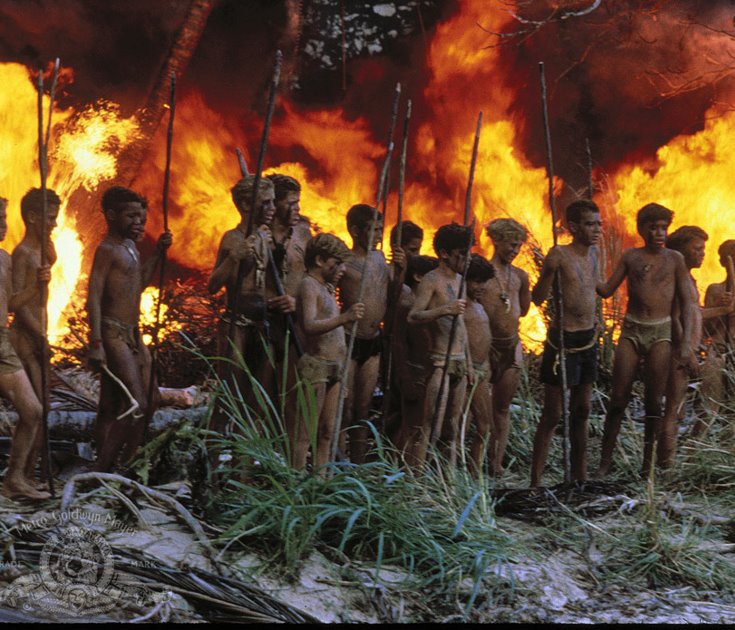
Scene from 1990 film version of Lord of the Flies (source)

Script of an assembly delivered by Hermione Baines and David Alcock via voiceover Powerpoint to Bradford Grammar School pupils on Friday 15 January 2021. The slide set and notes are available upon request from @DavidAlcock1

Deep down, what is human nature? What are we really like underneath?  Novelist William Golding explored this idea in his 1951 novel ‘The Lord of the Flies’.  It tells the story of a group of well-brought up English schoolboys, shipwrecked on a deserted island. To start with, the boys organise themselves and try to have fun and wait for rescue. However, as the days go by, their rules break down. As fear takes over, they descend into appalling savagery and violence.  We won’t spoil  the ending for those of you have not yet read it, but lets just say it doesn’t end well – as this still from a film of the book suggests​.

William Golding did not have a positive view of human nature – he said, ‘Even if we start with a clean slate, our nature compels us to make a muck of it’ and ‘Man produces evil as a bee produces honey’.

Thomas Hobbes by John Michael Wright (source)

Golding’s view of human nature is widely held. The 17th Century philosopher Thomas Hobbes considered what humans were like before we created ‘society’ – he argued that in a ‘state of nature’ human beings are driven by fear – fear of the other – our lives would be a state of permanent war and conflict – deep down, this is what we are.​

As a historian, it’s easy to find examples of humans being driven by fear, greed, and hatred to do terrible things to each other; it sometimes doesn’t seem to take much to turn apparently civilised human beings into aggressive, cruel creatures. Is this what humans, deep down, are like?

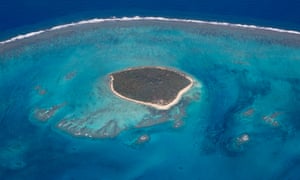
The island of ‘Ata (source)

This is the uninhabited island of ‘Ata.  It is 100 nautical miles from the main island of Tonga, which is itself 2000 nautical miles east of the Australian mainland.  What does it have to do with Golding – or indeed Hobbes?​

Well, in 1966, Peter Warner, an Australian man in his 20s, sailed his boat to the island, which had been deserted for over a hundred years.  But he saw fire – a sign of life – and when he drew closer he found six boys.  These six boys told him that they had ‘borrowed’ a boat from the main island of Tonga, they’d got caught in a storm, and eventually landed on Ata, fifteen months previously.  The boys were taken back to the mainland, where their families had given them up for dead.​

Six boys, on an island – a recipe for disaster, right? Rivalries, fighting, bullying?  No.  Quite the opposite.

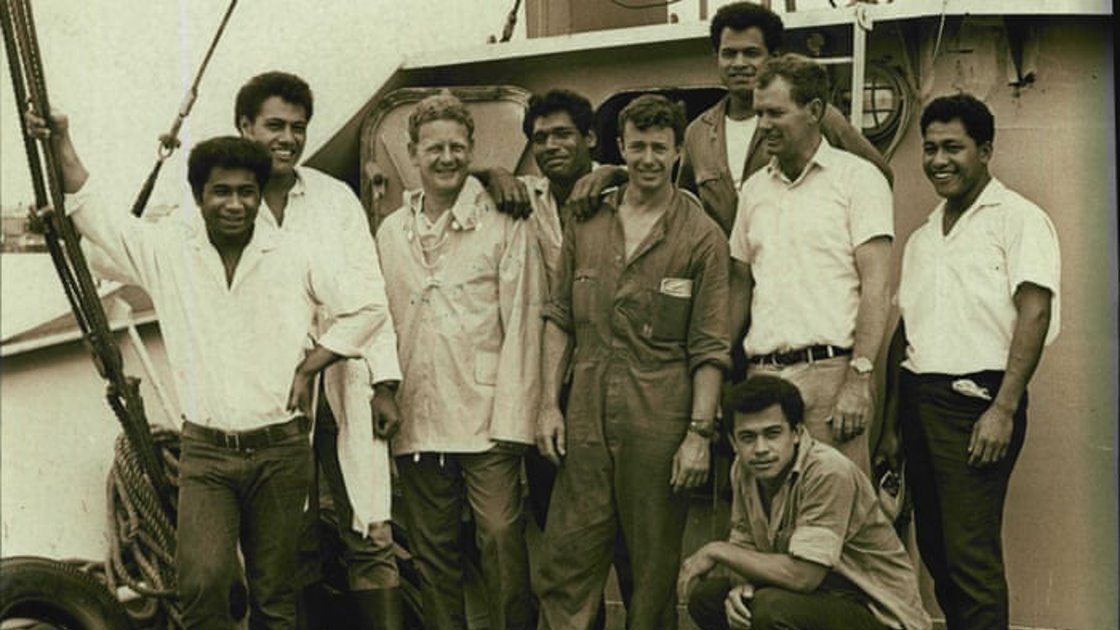
Peter Warner, crew, and the six boys, 1968 (source)

The boys – seen here in a reunion photo with Captain Warner a few years after the incident – had actually set up a small commune with food garden, hollowed-out tree trunks to store rainwater, a gymnasium with curious weights, a badminton court, chicken pens and a permanent fire, all from handiwork, an old knife blade and much determination.​

While the boys in Lord of the Flies come to blows over the fire, those in this real-life version tended their flame so it never went out, for more than a year.​

The kids agreed to work in teams of two, drawing up a strict roster for garden, kitchen and guard duty. Sometimes they quarrelled, but whenever that happened they solved it by imposing a time-out. Their days began and ended with song and prayer.​

Captain Warner wrote in his memoir:  “Life has taught me a great deal, including the lesson that you should always look for what is good and positive in people.”

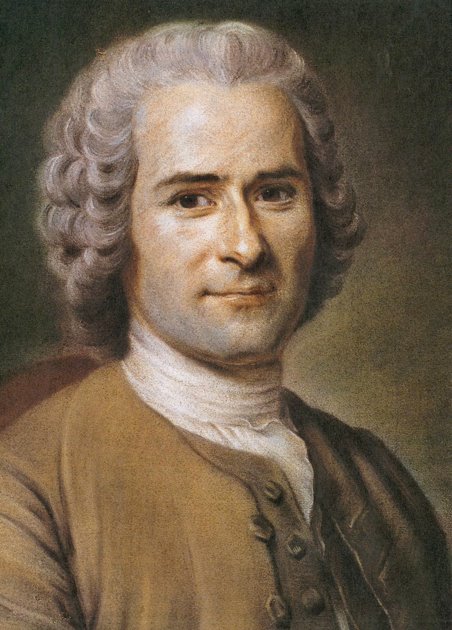
Jean-Jacques Rousseau by Maurice Quentin de la Tour (source)

One example doesn’t prove much.  But it got Dutch author Rutger Bregman thinking: was Golding’s book symptomatic of a negative view of human nature which doesn’t really reflect how most humans actually behave?​

​The philosopher Jean-Jacques Rousseau argued that in a state of nature, we are naturally cooperative beings: our essence is to work together.  But Bregman argues that Rousseau’s message has been overwhelmed by a more cynical image of humanity, which has been proclaimed in films and novels, history books and scientific research – and perhaps even in education?​

​Bregman argues that this distrust has been driven by individualism, an increasingly overdramatic media, and politicians keen to get the support of voters who are scared of ‘other people’ (does this remind you of a certain US president?).

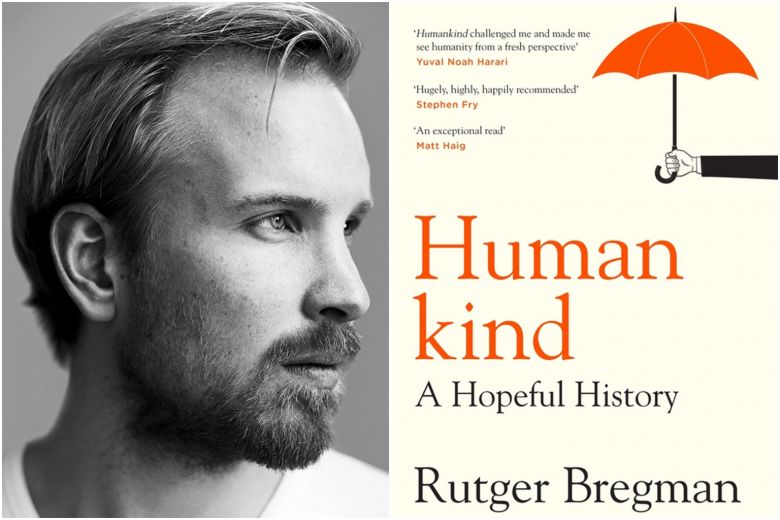
Rutger Bregman and Humankind cover (source)

Bregman has a hopeful message – he thinks we think ourselves worse than we really are, and this is what causes the problems because we assume that people are bad, when the vast majority of people are in essence good at heart – he asks us to take a positive view of the world.​

​We have been thinking that recent events – particularly the way people have coped with the pandemic – support this hopeful view of humankind. Despite some people behaving selfishly with no regard for the welfare of their fellow human beings, behavioural scientists suggest that the vast majority of people have been cooperating for the greater good, wanting to help each other and sticking to the rules, even when they could get away with breaking them.​

​As Bregman says,  We live on a planet where people are deeply inclined to be good to one another. Do good in broad daylight, and don’t be ashamed of your generosity. Its time for a positive view of humankind’.

[Inspired? Read about Hopeful Education – whose mission is to encourage young people to ‘evaluate progress, believe in humanity, and create a better world’ – in this post, and follow @HopefulEd on Twitter.]

Humankind by Rutger Bregman (2020) is published by Bloomsbury.