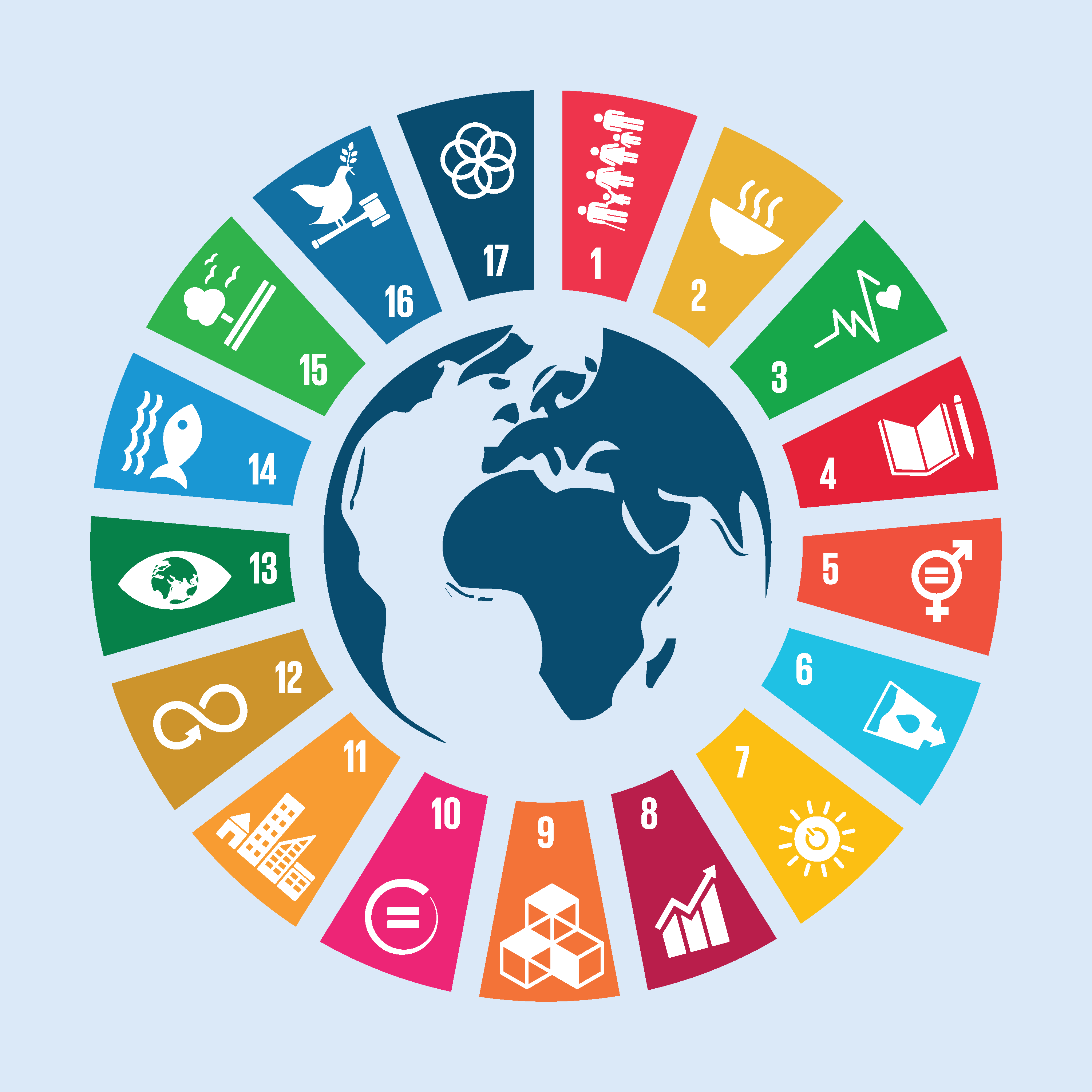
The UN’s Sustainable Development Goals (source: Brookings Institute)
Is it time to revisit ideas of ‘progress’ to answer critics of ‘development’ and to offer meaning in uncertain times?
Six years ago, my two-year old nephew was suddenly taken ill. He was diagnosed with leukaemia and spent several days in intensive care, before undergoing six months of treatments at Manchester Children’s Hospital. And whilst some of his fellow patients sadly never pulled through, Mateo did, and he is now a happy and healthy boy.
This would not have happened were it not for cumulative advancements in medical technology, economic prosperity, and the stable and successful governance which facilitated the welfare state over the preceding decades, plus many other ‘progressive’ trends which operate in the background.
Most people are quite comfortable talking about – and indeed celebrating – such advancements in isolation. But we have become increasingly wary of applying the word ‘progress’ to describe the combination of ways in which society has experienced ‘change for the better’.
And yet we have achieved many such changes, which I freely admit that I don’t tire of revisiting and repeating. For instance, for most of human history, around one in two children died before reaching the age of 15; by 2020, this had fallen to 4%. What a success! The global adult literacy rate was 36% in 1950; now it is 87%. Wow. The share of the world’s population without access to electricity has halved since 2000, from two in ten to one in ten. Take a moment to let these trends sink in.
Understandable wariness in referring to ‘progress’
Nevertheless, wariness in using the term ‘progress’ is understandable, as it is often associated with the grand, modernist, ideological projects which bruised and battered humanity in the twentieth century. It is also used when referring to large scale infrastructure schemes, many of which override the concerns and voices of local communities, for example ‘megadams’ such as the Three Gorges Dam in China, which displaced over a million people in the early 2000s.
‘Progress’ has also become associated with universalism, which has fallen out of favour in this era of multiple identities, growing suspicion of authority, and a questioning of objective truths. I have sympathy with those who regard the term with scepticism, as colonialism, neo-colonialism, and the oppression of minority voices and opinions has often been undertaken in the pursuit of ‘progress’ and ‘the greater good’. Frequently it is also seen as being synonymous with economic growth, shading out social, cultural, and environmental considerations of what makes a flourishing society.
The failings of ‘development’
But in many ways, ‘progress’ is preferable to the term ‘development’, which has been under attack by critical thinkers over recent decades for implying a unilinear, ‘one size fits all’, path for all countries to follow on the way to economic prosperity. Critics often balk at those who refer to countries as being ‘under-developed’ or ‘less developed’, as these terms imply that some parts of the world are inferior to others. Moreover, to call a country ‘developed’ implies that it has reached its goal: the term masks the inequalities, injustices, and other social and environmental challenges that are present everywhere.
‘Development’ also implies growth, which, when applied to the consumption of materials and energy, and, some would argue, the scale of economies, is difficult to achieve in an environmentally sustainable fashion. As Johann Rockström and colleagues at the Stockholm Resilience Centre have demonstrated, we have already overshot six of the nine planetary boundaries within which humanity can continue to thrive for generations to come. It is taking too long for us to wake up to the fact that infinite growth is impossible in a finite world.
Attempts to modify the concept of ‘development’ by aiming for ‘sustainable development’ deserve widespread support – and the United Nations Sustainable Development Goals are perhaps the best framework we currently have to formulate shared global goals. However, we should be wary of the now ubiquitous use of the term ‘sustainable’, which can be stretched and misused.
Reclaiming and chastening ‘progress’
So, is it time to revisit using a chastened notion of ‘progress’ to help guide us to consider where we want to be as a society? Can we reclaim it from being associated with ideological steamrolling aimed at imposing economic systems or social conformity? Can we rescue it from being pigeonholed as being labelled as an archaic ‘western’ notion and reaffirm the fact that its moral underpinnings are universal to humankind? Can we shear it of its Enlightenment excesses and yet retain the germ of the idea that ‘gradual improvement’ of the lot of humanity is a worthwhile goal?
It would be tough mission, but we could begin by trying to hold Max Roser’s ‘three truths’ in our mind simultaneously:
- In many respects, the world is awful (4% of children die before they are 15)
- The world is much better than it used to be (in the past, half of children died)
- The world can be much better (in the EU, 0.45% of children die)
Within the sphere of education, teachers could lift our students’ eyes above the narrow quest to achieve qualifications, allowing them to interrogate concepts of progress as part of the process of socialisation, and to offer a source of meaning and direction.
And beyond schools, we should bring a wide variety of voices into discussions about progress. We should deliberate what it means and what it could mean, as the concept is not set in stone. Uncertain times call for such ‘big picture’ thinking – are you up for the challenge?
A version of this post appeared in the Yorkshire Post, 26th March, 2025, to coincide with a symposium on Education, Knowledge and Progress which I spoke at and was part of the organising team for, at the Institute of Education, UCL, London, on 26th March.


 alcockblog