An account of a ‘No-Recce’ Joss Naylor Lakeland Challenge, 18 July 2026
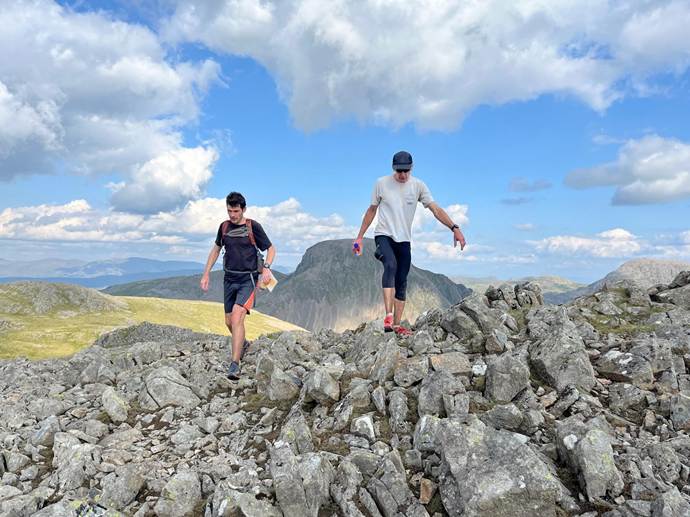
Nathan and me on Kirk Fell, looking back to Great Gable (photo: Toby Fisher)
Cutting it fine is a speciality of mine[1], but I managed to surpass myself twice on Saturday 18th July.
Between the two occasions lay 30 Lakeland peaks and about 48 miles. Oh, and the small matter of 16,000 feet of ascent and descent, which is the equivalent of going up and down two Ben Nevises and two Scafell Pikes from sea level. Here is a video of the route, and below is a map of it:
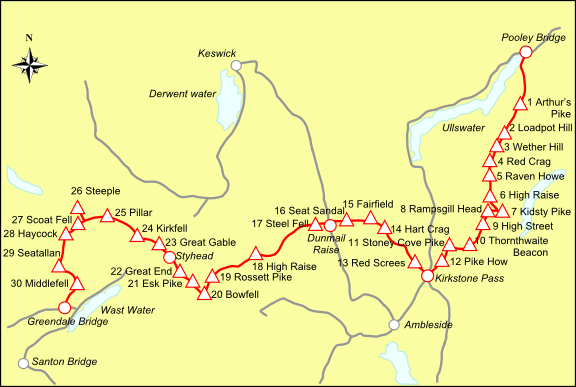
The thirty peaks of the Joss Naylor Challenge, plus its two road crossings and Styhead Pass checkpoint (source: Fastest Known Time)
This is the challenge that legendary fell runner Joss Naylor set for over fifties to achieve in under twelve hours (read this short but gripping account of his inaugural journey in bad weather conditions in 1990), and for some reason I was taken by the idea of holding back the years and conquering the fells.
On both occasions, my deadline-pushing was self-inflicted, but I had more control over the first one. I had arranged to meet my old housemate and stratospherically more talented running friend Chris Birchall at the car park in Pooley Bridge by 7.45am, to get kitted up for the challenge. We (my wife Helen and I, with our sons Charlie and Alfie) had stayed at the nearby house of other Leeds Uni running pals – Danny and Lucy Jones – overnight and we left there a little late. At least I had packed my bag, and prepared bags of snacks and drinks for the day’s exploits. But we still needed to find Chris, juggle the kit around, and transfer his bike to our car.
We reached him at 7.55, ten minutes later than planned: not a great omen for keeping to time on a day with so many deadlines. You might guess by now that the second deadline, 12 hours later, also involved cutting it fine.
There was an added challenge, though – I had never set foot on some of the route, and I had only visited some of the summits a decade or so ago, if at all. Most people take several months or even a year to check out the route, the timings, and the condition of the paths, but being over-committed to various things in my 49th and 50th years – mostly self-inflicted – meant that this was going to be possibly the first ever No-Recce Joss Naylor Challenge.
During 2026, I had built up my mileage from its usual ten miles or so a week to twenty or so, which, combined with my work cycle commute, weekly swim, and one or two strength and conditioning sessions a week, gave me a good foundation on which to build on. I outline a typical week at the end of this article. I had taken on some long-distance challenges, such as the Rombald’s Stride, with my son Charlie, and the Saunders mountain marathon with my second-half pacer in the ‘Joss’, Nathan Martin. In the Saunders, two weeks earlier, Nathan I were second out of 127 teams, and first vet team in the Fairfield category. The event involved running and navigating over tough Lakeland terrain for seven hours on the Saturday and five hours on the Sunday. As 7 + 5 = 12, then by my optimistic logic I had shown that I could complete twelve hours of tough fell running in one weekend. But I never quite managed to carve out even a day to check out the trickiest sections of the route, so I ended up relying on reading accounts of past attempts, looking at maps, and asking my pacers to help me to navigate our way through the fells on the day.
There now follows an account of the challenge, partly for posterity, partly to thank my support crew, partly to fulfil the conditions of my attempt being ratified, and partly to inform others who may be contemplating the challenge.
Leg 1 – 16 miles, 3000 feet ascent (actually a little less than 16 miles according to Chris’s GPS)
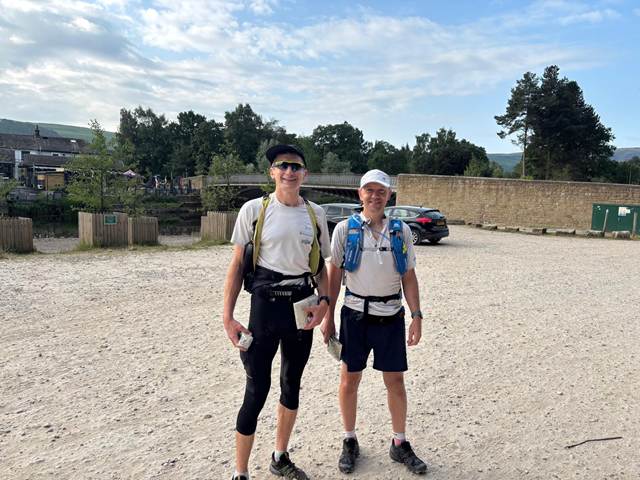
Just before setting off, with Chris Birchall. The eponymous Pooley Bridge is in the background (photo: Helen)
Having highlighted the route and peaks on some old maps the day before (very ‘lastminute.com’ – can you see a trend developing?), I knew roughly where we were going, and, as expected, the chat with Chris also flowed well. He and his now wife Emily had paced me on leg 2 (Helvellyn ridge) of my 2009 Bob Graham Round so I knew he was an excellent pacemaker, and I was over the moon when he signed up to help me to attempt ‘The Joss’.
I also knew the first leg required almost non-stop running, with some short stretches of walking up medium-to-steep sections, and Chris gave positive feedback throughout, to help keep the pace brisk. I also knew from reading previous accounts that I was likely to be at least ten minutes behind schedule by the end of this leg. We had indeed dropped back by about eight minutes after 90 minutes of running, then we held it constant for a while, then we dropped another few minutes on the tougher peaks at the end of the leg, before descending diagonally to the other supporters at Kirkstone Pass for a five minute ‘rest’ and refuel.
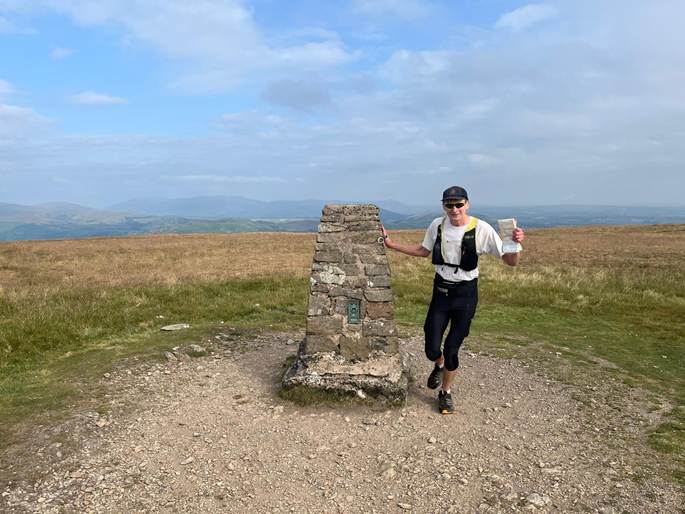
On Arthur’s Pike, the first peak of the challenge (photo: Chris B)
| Place | Schedule | Split | Actual | Time behind 11hr 40min schedule |
| Pooley Bridge – Dep Pacer: Chris Birchall | 08:00 | 00:00 | 00:00 | 0 |
| Arthur’s Pike | 08:35 | 00:35 | 08:33 | 2 |
| Loadpot Hill | 08:54 | 00:19 | 08:58 | 4 |
| Wether Hill | 09:03 | 00:09 | 09:07 | 4 |
| Red Crag | 09:13 | 00:10 | 09:18 | 5 |
| Raven Howe | 09:17 | 00:04 | 09:24 | 7 |
| High Raise | 09:25 | 00:08 | 09:34 | 9 |
| Kidsty Pike | 09:31 | 00:06 | 09:39 | 8 |
| Rampsgill Head | 09:35 | 00:04 | 09:43 | 8 |
| High Street | 09:49 | 00:14 | 09:57 | 8 |
| Thornthwaite Beacon | 09:57 | 00:08 | 10:07 | 10 |
| Stony Cove Pike | 10:16 | 00:19 | 10:27 | 11 |
| Pike Howe | 10:22 | 00:06 | 10:37 | 15 |
| Kirkstone – Arr | 10:35 | 00:13 | 10:48 | 13 |
Leg 2 – 8 miles, 3,200 feet ascent
The Kirkstone Pass car park was extremely busy, but luckily Helen and long-time uni friends Lucy and Chris Needham found places for their cars and I was grateful for the deckchair; I changed from trail shoes to fell shoes, and took on board lots of liquid, having had to use some of Chris’s on leg 1 owing to the humid conditions. I ate a banana and grabbed a peanut butter sandwich to eat on the ascent of Red Pike, knowing that the calories would be crucial later on.
Lucy set a perfect pace on this leg. She knew the route exceptionally well too, thanks to her experience doing leg three of the Ian Hodgson Fell Relay. The toughest descent was coming off Fairfield, as it was so gravelly, and the steepest climbs were Red Screes at the start and Seat Sandal at the end.
Lucy and I were boosted at the latter peak by her husband Chris, who called out support from afar and laid out sweets and drinks on the summit. Whilst descents are normally my speciality, I lost four minutes on the way down from Seat Sandal, as I felt that my legs would have complained later in the day if I had hurled myself down this one, and my left big toe began to get sore, so I covered it with zinc oxide tape at the road crossing – which was the second and last such checkpoint on the journey.
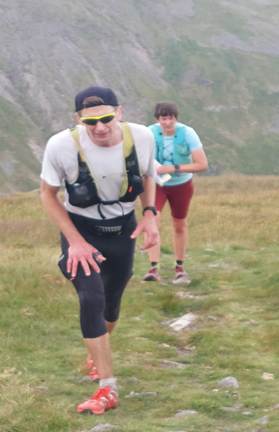
The final few steps up Seat Sandal, with Lucy (photo: Chris N, who laid out sweets and drinks for us!)
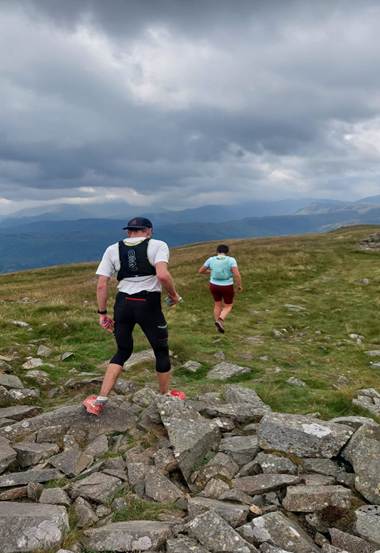
Leaving Seat Sandal, with Lucy leading the way down (yes, my posture really is that bad) (photo: Chris N)
| Place | Schedule | Split | Actual | Time behind 11hr 40min schedule |
| Kirkstone – Dep Pacer: Lucy Needham | 10:40 | 00:05 | 10:53 | 13 |
| Red Screes | 11:00 | 00:20 | 11:14 | 14 |
| Hart Crag | 11:41 | 00:41 | 12:01 | 20 |
| Fairfield | 11:53 | 00:12 | 12:14 | 21 |
| Seat Sandal | 12:12 | 00:19 | 12:34 | 22 |
| Dunmail Raise – Arr | 12:25 | 00:13 | 12:51 | 26 |
Leg 3 – 11 miles, 4,900 feet ascent
I knew I was pushed for time, so I made sure that I curtailed the Dunmail Raise break, and gained four minutes back by doing so – this would prove to be very valuable later on! On this leg, I welcomed the solid fellcraft of Nathan and adventure runner and orienteer Ian Furlong.
I know I have called this a ‘no recce’ attempt, but having helped at and completed the Bob Graham Round, some of the route was fairly familiar to me, and the hoik up Steel Fell was one such section. This climb always seems to go a bit easier than it looks like it ought to – and I needed this to be the case. However, the section after that was the biggest drag of the day – I lost nine minutes, despite Nathan and Ian seeking out every last trod. One problem was my energy, but another was the length of the grass – it was longer than I remember it being up at this altitude – the sign of a wet winter and a dry and sunny spring and summer, perhaps?
The next descent went briskly, but I noticed that Ian was falling behind – Nathan told me that his hip was playing up. Nathan also told me that he had left his phone at home. My phone flashed something up like ‘emergency use only’ so I suspected that my Strava trace would also be lost soon – and Nathan wasn’t tracking it either. At least I had an Apple tracker, borrowed from Ian. But I doubted there’d be Strava proof of the day’s attempt, so it’d be down to good old-fashioned signatures on the declaration form at the end of the day to prove that I had completed the challenge.
We found and followed the diagonal trod up Bowfell, and passed a great little stream near the start; the water tasted beautiful and I again took the chance to wet my head and face to cool off. Nathan and I swapped tales of climbing the trod in much less clement conditions on our Bob Graham recces. We summited and this was the first time that Nathan didn’t tell me how much time we had gained or lost, so I suspected that we were falling behind. This was also when I lost track of which peak was next and just took Nathan’s word for it – as my mountain marathon partner, I trust him absolutely.
We got up and over the rocky summits of Esk Pike and Great End (meeting Ian along the way – he told us he’d be heading down to Wasdale, so at least we knew he was safe), and as I descended I could see Helen, the boys, and Toby, which spurred me on.
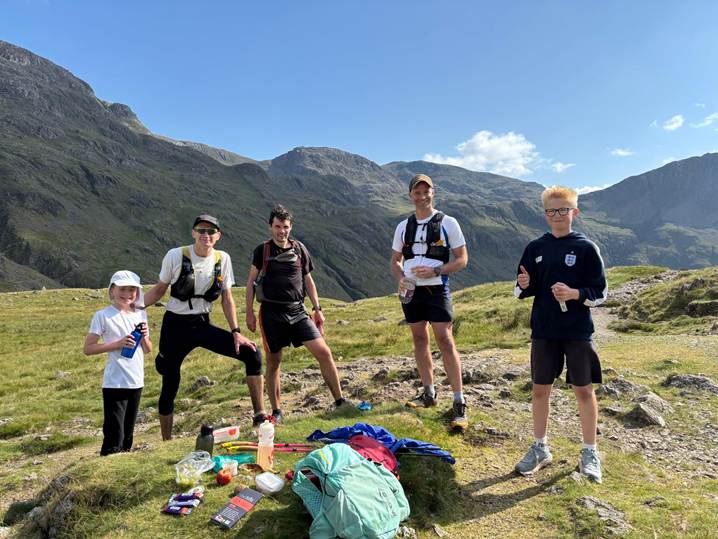
At Styhead Pass at the end of Leg 3 – L-R Alfie, me, Nathan, Toby, Charlie (photo: Helen)
| Place | Schedule | Split | Actual | Time behind 11hr 40min schedule |
| Dunmail Raise – Dep Pacer: Nathan Martin and Ian Furlong | 12:35 | 00:10 | 12:57 | 22 |
| Steel Fell | 12:55 | 00:20 | 13:19 | 24 |
| High Raise | 13:40 | 00:45 | 14:13 | 33 |
| Rossett Pike | 14:16 | 00:36 | 14:49 | 33 |
| Bowfell | 14:40 | 00:24 | 15:18 | 38 |
| Esk Pike | 15:00 | 00:20 | 15:40 | 40 |
| Great End | 15:19 | 00:19 | 16:00 | 41 |
| Sty Head – Arr | 15:40 | 00:21 | 16:20 | 40 |
Leg 4 – 13 miles, 5,00o feet ascent
Meeting the family in the sun at the end of Leg 3, having halted my time losses, gave my spirits a boost, so we pushed up Great Gable with the sun shining and a lovely breeze blowing. Nathan and I were joined by Toby Fisher, who I had come to know well from the Guiseley Dads group and local fell races. He asked me what he could do to help, so I gave my race vest to him, and this put a spring in my step too; we knocked four minutes off the schedule on the way up to Great Gable. But I was under no illusion as to the scale of the task, as we were still 36 minutes behind the 11 hour 40 minute schedule, which, if we halted the losses, still meant that I would finish 16 minutes over the 12 hour limit at the end.
We clawed back another five minutes over the next five peaks, with Nathan and Toby giving me fantastic encouragement all of the way! The schedule only allowed five minutes to get from Scoat Fell to Steeple, and we did it in 4 minutes and 30 seconds, but then I found it hard going, and I expressed disbelief at the steepness of the remaining three climbs – in my mind’s eye, after Kirk Fell, the Wasdale peaks were more or less a horseshoe ridge with very little up and downs involved! Obviously I had blanked out memories of the reverse horseshoe in the Bob Graham from my mind!
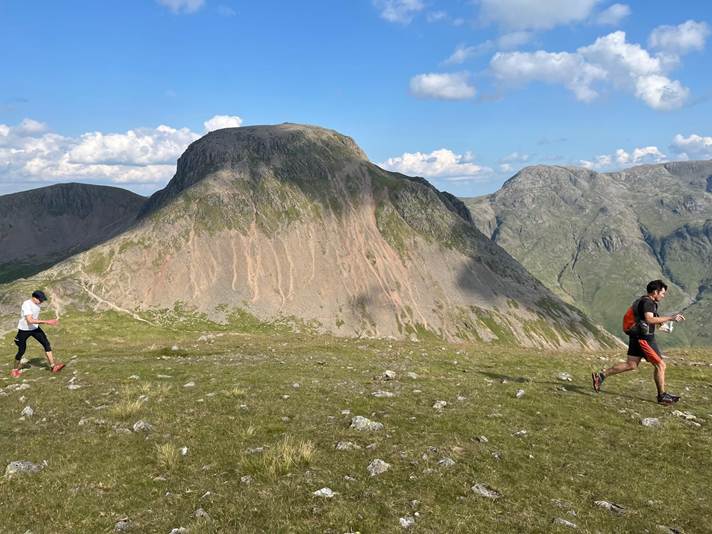
On Kirk Fell, looking back to Great Gable (L) and Bowfell (I think) (R). To think that less than two hours separated Bowfell from Kirk Fell gives some idea of the pace needed to traverse these peaks. The pinkest line down the scree slope is also approximately where we descended Great Gable (miraculously with no scree fragments in our shoes!) (photo: Toby)
Nathan and me on Kirk Fell, looking back to Great Gable (photo: Toby)
Toby gave me back my race vest at a stream somewhere near the col between Haycock and Seatallan, as the pace picked up and he said he might not be able to keep up – and indeed he later decided to miss out on Middle Fell, giving him a distant view as the action unfolded. Nathan told me that it would be ideal to reach Seatallan by 7.25, and I made it at 7.26. He said there were 4km left, but with at least 100m of ascent I knew it would be a tall order to manage this in less than 34 minutes. The tussocky descent from Seatallan also came as a bit of a nasty surprise, and Nathan said I needed to get my afterburners on to be in with a chance – and if I did, sub-12 hours was “still on”. I pushed it up Middle Fell, getting my compass ready with a SW bearing to get the correct path off the top, then we pushed along the knolly ridge, before I passed my vest to Nathan and began a hair-raising full-focus descent.
The schedule said 20 minutes, and on the ascent we aspired to leave the top at no later than 7.45. As my watch read said 7.44 at the summit, I knew I’d have to push it the whole way down. The path had a few small rock steps but was otherwise mainly gravel, but it did twist and turn a bit – I was desperate not to trip as recovering would not only have cost me time in itself, but it may have also resulted in deadline-defeating injury or cramp. I willed the distant farm and valley floor to rise towards me and ran as fast as I could, only glancing at my watch on some relatively safe sections.
The farm still seemed a fair distance away when I passed a couple of bemused walkers on their way up. A few minutes later I began to make out some voices, shouting words of encouragement. Then I saw the white t-shirt of my son Alfie poking out between the bracken. He pointed me onto the correct path at a fork right near the end, then the path opened out onto a grassy parking area, where Helen took a photo and shouted me on, with Alfie in hot pursuit and my son Charlie joined in on the 50 metre run to the bridge, where Ian was stood with his arm out as a makeshift finish line. I crossed it, then bent over, sat on the ground, then did what I had been looking forward to doing for the previous couple of hours at least – lie on the ground. I had made the descent in 13 minutes and finished the whole challenge with less than three minutes to spare – cutting it exceptionally fine indeed!
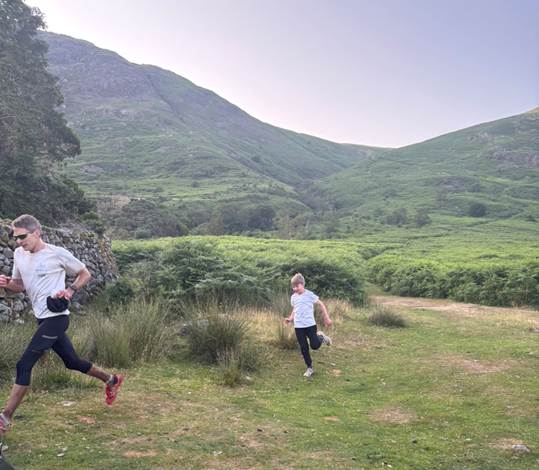
Running in with three minutes to spare, pursued by Alfie, who had called me onto the correct final path (photo: Helen)
| Place | Schedule | Split | Actual | Time behind 11hr 40min schedule |
| Sty Head – Dep Pacers: Nathan, Ian, and Toby Fisher | 15:45 | 00:05 | 16:25 | 40 |
| Great Gable | 16:19 | 00:34 | 16:55 | 36 |
| Kirk Fell | 16:56 | 00:37 | 17:29 | 33 |
| Pillar | 17:44 | 00:48 | 18:16 | 32 |
| Scoat Fell | 18:03 | 00:19 | 18:35 | 32 |
| Steeple | 18:08 | 00:05 | 18:39 | 31 |
| Haycock | 18:23 | 00:15 | 18:56 | 33 |
| Seatallan | 18:55 | 00:32 | 19:26 | 31 |
| Middle Fell | 19:20 | 00:25 | 19:44 | 24 |
| Greendale Bridge – Arr | 19:40 | 00:20 | 19:57 | 17 |
The Finish
Helen, Charlie, Alfie and Ian were joined by Nathan, who caught me up a couple of minutes later, and Toby, who came from Middle Fell. It was all I could do to try to control my breathing and say thank you to the support crew.
I managed to hobble off the road to lie down on the grassy car park, where Alfie passed me a coat to keep my heat in. I got in the car around fifteen minutes later, but the strawberries and milk which I consumed at the end soon came back up, and I will spare the details of the evening’s other illness-related incidents, other than to say that after keeping down a mouthful or two of water at the campsite, I slept in the same t-shirt I had worn all day, without the energy or bravery to take the cold shower that was on offer (especially not at £2 for the privilege!).
My sleep was helped by Squawky. This was Charlie and Alfie’s fluffy toy bird, who he tasked with looking after me through the night – a job which he performed admirably. Good old Squawky.
As with all similar challenges, the attempt was pretty selfish, and I relied upon others at all stages. But I hope the friends and family who helped on the day also got something out of my ‘grand day on the fells’. Moreover, I am on tap to help with other attempts, and I hope that this account might help others who want to have a go. I did indeed succeed in doing a no-recce sub-12 hour ‘Joss’, but nevertheless I heavily recommend that future contenders should check out some routes beforehand and they should also have a word with Mother Nature to arrange perfect weather for their attempt.
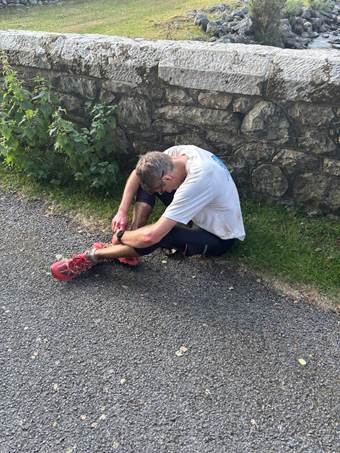
Wrung-out after finishing in 11hr 57min (photo: Helen)
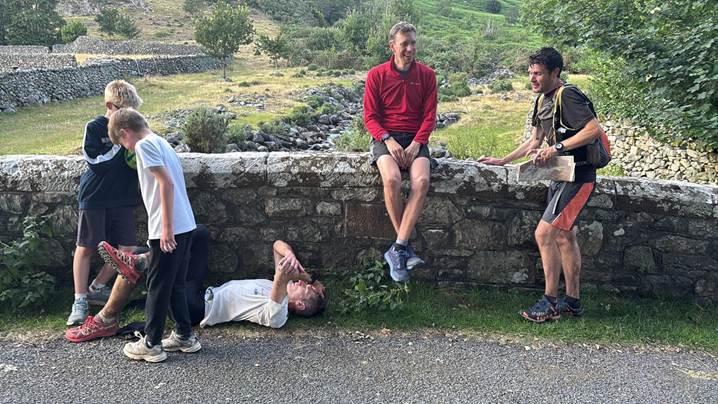
I believe this is what is known as a tableau: a picture that tells a story. It is also the nearest we got to getting a group photo at the end, just after Nathan finished – a couple of minutes after me, wearing mine and his race vests and having navigated all of legs 3 and 4 (photo: Helen)
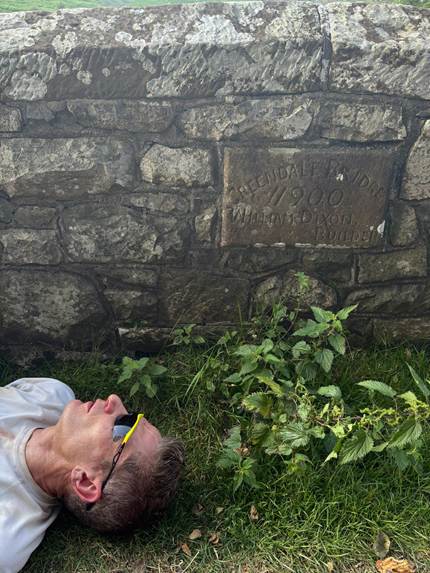
The engravers of the Greendale Bridge plaque never knew it would signify the finish line of such a punishing challenge (photo: Helen)
The day after:
Still wearing the same t-shirt as the day before, with my legs still as dirty, but feeling much, much, better after about eight hours’ sleep, I woke up at Sturdy Bank campsite, Grizebeck. Helen had slept in the three-man tent with Charlie and Alfie. Following a bowl of cereal and cold coffee from yesterday’s flask, I went with the family to the Yorkshire and Humberside Orienteering Association Sprint Championship in Harrogate, and managed to finish third M50! I kept the zinc oxide tape on my left big toe, but otherwise had no sore bits – my leg muscles ached a bit, but it was my heart and lungs which were mainly telling me to take the pace down a notch or two!
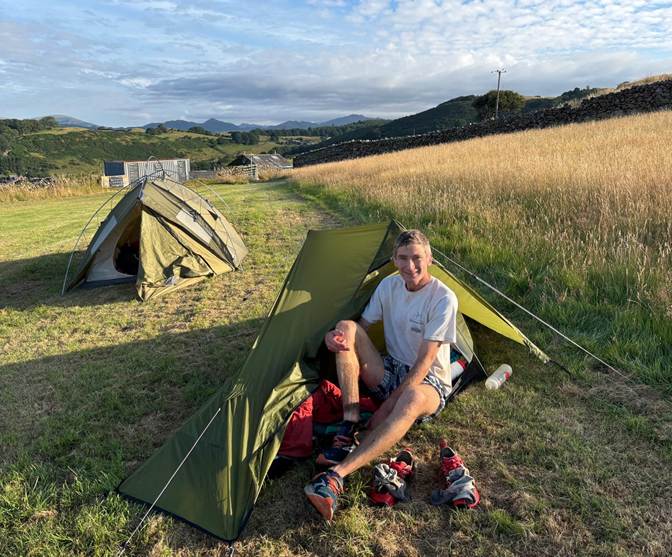
Feeling a lot better the morning after, at Sturdy Bank Campsite, Grizebeck
Notes on kit and food:
Trail shoes worked for me for the first leg, with just the last two descents needing a little more care. Inov8 fell shoes were invaluable for the rest of the day.
I wore the same white breathable t-shirt (from the 2005 Matterhornlauf) that I wore for my 2009 Bob Graham Round, to give me a bit of luck (and to keep me cool). I had Alpkit ¾ length tights, which have very useful side storage pockets, for my compass, a gel or two, and an ‘emergency’ 150ml drink. I also wore my ‘ten year’ Saunders cap and a pair of sunglasses.
I kept my phone in a plastic bag in a slim pocket-belt device. I should have charged it up overnight as it ran out of juice after 34 miles. It was also useful for Helen to call me on the run to discuss logistics towards the end of leg 1. There were two maps per leg, though I only read the one for leg 1, as Lucy knew her way on leg 2, and Nathan and Ian navigated flawlessly on legs 3 and 4, as my mind started to focus on survival mode!
I had a few soft water pouches and my trusty 500ml High 5 joggers’ bottle, which I filled up from streams. I often dipped my cap in streams to cool me down.
I got through three bananas, 3-4 caffeine gels, a peanut butter sandwich, lots of High 5 energy gummies, some leftover Kendal mint cake from the Saunders, a couple of cereal bars, and plenty of assorted sweets. The support team filled lots of bottles with High 5 energy powder and prepared other electrolyte-rich drinks. I weighed myself the next day (don’t forget I was sick around an hour after my attempt, and couldn’t keep any food down until breakfast) and I think I lost about 5 pounds, taking me to 11 stone 1.
The temperature was just right for most of the run, except for a couple of humid patches early in the day. There was a nice breeze for some of it later on, which helpfully came from the north-west. The ground was dry, and hard in most places (with a slight cushion on the grassiest slopes). I would have been stuffed had the ground been softer or the weather less clement: Joss’s original 1990 traverse sounds like a nightmare (the original account is on the JNLC blog).
Typical training week:
| Day | Activity |
| Monday | Bike to and from work (5.5 miles each way) |
| Tuesday | Bike to and from work (5.5 miles each way); lunchtime XC club run: c 3 miles; fortnightly 15 min swim before school |
| Wednesday | Bike to and from work (5.5 miles each way); usually either lunchtime O club or evening O (usually shadowing) |
| Thursday | Bike (or run, some weeks in Feb-April) to and from work (5.5 miles each way); fortnightly 15 min swim before school |
| Friday | Rest |
| Saturday | Orienteering or rest or occasionally a run if I wasn’t going to do one on Sunday (sometimes longish – up to 14 miles) |
| Sunday | Orienteering or rest or occasionally a run if I didn’t do one on Saturday (sometimes longish – up to 14 miles) |
I also enjoyed quite a few walks with the family in the run-up to the challenge, including some challenging ones, such as a great day on Goatfell on Arran at Easter. School holidays shook up the routine and typically brought down the run/bike mileage. I am convinced that green gym (gardening, especially hedge trimming in a heatwave) also helped too! Some moderate strength and conditioning may also have played a part (about once a week). I have had no more than two days without exercise for as long as I can remember and I have a 572 week (11 year) Strava streak (although I didn’t even know there were Strava streaks until a few months ago!).
Thank you everyone again for all of your help!
If you are able to, please donate to WaterAid via this link:
www.justgiving.com/page/david-alcock-1
The joy of having access to fresh stream water at various points on the route and supplies of drinking water passed to me by members of the support team throughout the challenge is not one I take for granted, and I believe that others in the world should have access to drinking water and sewerage.
- David, 26th July 2026.
[1] My long-suffering pal Leon refers to a phenomenon called ‘Alcockian time’. This is the time I intend to be somewhere, which tends to be significantly earlier than the time I’ll actually appear. My sister won’t mind me saying that this trait appears to be genetic.
 alcockblog