Is it time to revisit ideas of ‘progress’ to answer critics of ‘development’ and to offer meaning in uncertain times?
Six years ago, my two-year old nephew was suddenly taken ill. He was diagnosed with leukaemia and spent several days in intensive care, before undergoing six months of treatments at Manchester Children’s Hospital. And whilst some of his fellow patients sadly never pulled through, Mateo did, and he is now a happy and healthy boy.
This would not have happened were it not for cumulative advancements in medical technology, economic prosperity, and the stable and successful governance which facilitated the welfare state over the preceding decades, plus many other ‘progressive’ trends which operate in the background.
Most people are quite comfortable talking about – and indeed celebrating – such advancements in isolation. But we have become increasingly wary of applying the word ‘progress’ to describe the combination of ways in which society has experienced ‘change for the better’.
And yet we have achieved many such changes, which I freely admit that I don’t tire of revisiting and repeating. For instance, for most of human history, around one in two children died before reaching the age of 15; by 2020, this had fallen to 4%. What a success! The global adult literacy rate was 36% in 1950; now it is 87%. Wow. The share of the world’s population without access to electricity has halved since 2000, from two in ten to one in ten. Take a moment to let these trends sink in.
Understandable wariness in referring to ‘progress’
Nevertheless, wariness in using the term ‘progress’ is understandable, as it is often associated with the grand, modernist, ideological projects which bruised and battered humanity in the twentieth century. It is also used when referring to large scale infrastructure schemes, many of which override the concerns and voices of local communities, for example ‘megadams’ such as the Three Gorges Dam in China, which displaced over a million people in the early 2000s.
‘Progress’ has also become associated with universalism, which has fallen out of favour in this era of multiple identities, growing suspicion of authority, and a questioning of objective truths. I have sympathy with those who regard the term with scepticism, as colonialism, neo-colonialism, and the oppression of minority voices and opinions has often been undertaken in the pursuit of ‘progress’ and ‘the greater good’. Frequently it is also seen as being synonymous with economic growth, shading out social, cultural, and environmental considerations of what makes a flourishing society.
The failings of ‘development’
But in many ways, ‘progress’ is preferable to the term ‘development’, which has been under attack by critical thinkers over recent decades for implying a unilinear, ‘one size fits all’, path for all countries to follow on the way to economic prosperity. Critics often balk at those who refer to countries as being ‘under-developed’ or ‘less developed’, as these terms imply that some parts of the world are inferior to others. Moreover, to call a country ‘developed’ implies that it has reached its goal: the term masks the inequalities, injustices, and other social and environmental challenges that are present everywhere.
‘Development’ also implies growth, which, when applied to the consumption of materials and energy, and, some would argue, the scale of economies, is difficult to achieve in an environmentally sustainable fashion. As Johann Rockström and colleagues at the Stockholm Resilience Centre have demonstrated, we have already overshot six of the nine planetary boundaries within which humanity can continue to thrive for generations to come. It is taking too long for us to wake up to the fact that infinite growth is impossible in a finite world.
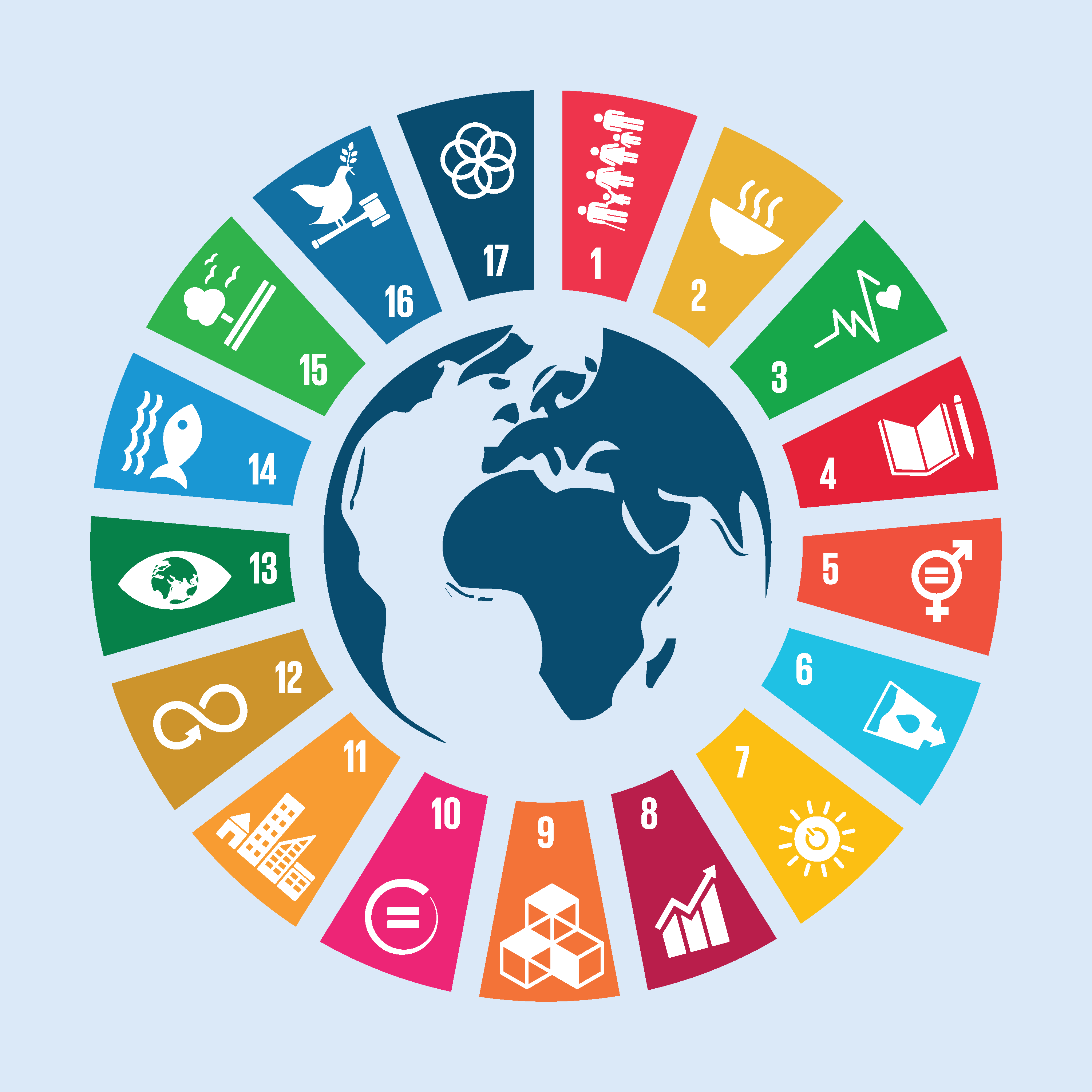
Attempts to modify the concept of ‘development’ by aiming for ‘sustainable development’ deserve widespread support – and the United Nations Sustainable Development Goals are perhaps the best framework we currently have to formulate shared global goals. However, we should be wary of the now ubiquitous use of the term ‘sustainable’, which can be stretched and misused.
Reclaiming and chastening ‘progress’
So, is it time to revisit using a chastened notion of ‘progress’ to help guide us to consider where we want to be as a society? Can we reclaim it from being associated with ideological steamrolling aimed at imposing economic systems or social conformity? Can we rescue it from being pigeonholed as being labelled as an archaic ‘western’ notion and reaffirm the fact that its moral underpinnings are universal to humankind? Can we shear it of its Enlightenment excesses and yet retain the germ of the idea that ‘gradual improvement’ of the lot of humanity is a worthwhile goal?
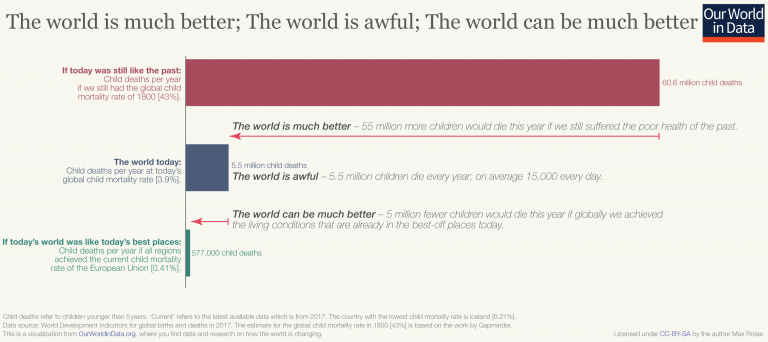
It would be tough mission, but we could begin by trying to hold Max Roser’s ‘three truths’ in our mind simultaneously:
In many respects, the world is awful (4% of children die before they are 15)
The world is much better than it used to be (in the past, half of children died)
The world can be much better (in the EU, 0.45% of children die)
Within the sphere of education, teachers could lift our students’ eyes above the narrow quest to achieve qualifications, allowing them to interrogate concepts of progress as part of the process of socialisation, and to offer a source of meaning and direction.
And beyond schools, we should bring a wide variety of voices into discussions about progress. We should deliberate what it means and what it could mean, as the concept is not set in stone. Uncertain times call for such ‘big picture’ thinking – are you up for the challenge?
A version of this post appeared in the Yorkshire Post, 26th March, 2025, to coincide with a symposium on Education, Knowledge and Progress which I spoke at and was part of the organising team for, at the Institute of Education, UCL, London, on 26th March.
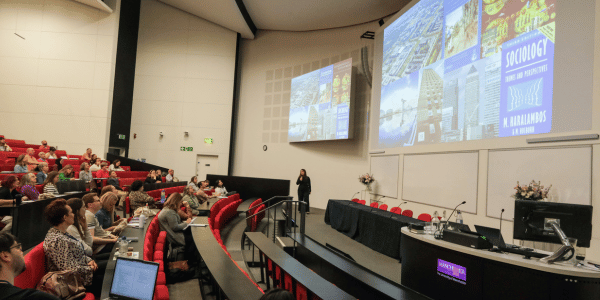
Just one of the dozens of sessions at the 2024 Geographical Association Conference (source: GA)
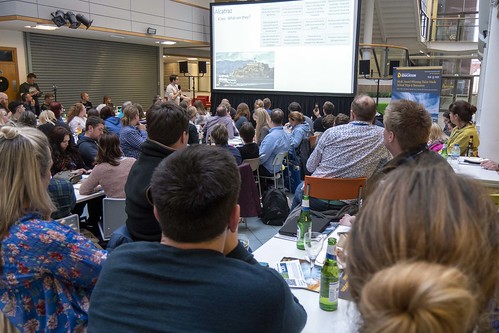
You’ve been teaching for a while. You’ve got the textbooks, the notes, the resources, and you have a good team around you at school. And of course you’ve got the internet. So why add to life’s complexities and expenses and go to conferences as well? And what should you do when you do attend?
I attended the GA Conference for a couple of years as a new teacher, but then fell out of the habit, only to return in recent years, with a renewed zeal about engaging in these hubs of geographical ideas and collegiality, and I present most years, on a variety of topics.
I hope that by sharing some thoughts about conferences I might inspire you to attend and to think about how you can overcome some barriers which might prevent you from doing so. In this brief guide, I cover the reasons for going, and I have put together some ideas for what you might want to consider before, during, and after attending them.
Why go?
Why should you go to a teaching or academic conference? As a teacher and a part-time postgraduate student, I can see the value of both types, and whilst some of the reasons for attending one type of conference will be different to those for attending the other, there is considerable overlap between the two, and this section attempts to cover both.
– To refresh your thinking, curriculum, and pedagogy. Conferences allow you to keep up to date with what’s happening outside of your ‘bubble’, whether that is your school, your exam board, your circle of colleagues, friends and influencers, or just your geographical milieu.
– To expose your ideas to others. This will especially be true if you present a talk or a workshop, but it also applies to question-and-answer sessions and informal discussions.
– To network. I have often shied away from this term, as it seems very transactional, but as well as being a way to look for work and new projects, networking also serves to keep you informed and refreshed in your current and future roles and activities. You may also be able to pass on opportunities or advice to other attendees, whatever your or their role might be.
– To keep your subject and/or discipline alive, fresh, and thriving. Ideas die in a vacuum, and so do subjects. However small, your attendance and involvement in conferences will help to maintain and enhance the viability and relevance of the subject in a challenging school and academic environment.
You will, of course, have other reasons for attending, and one of mine is to take a break from my usual routines and to regain the ‘travelling bug’. We like to preach about students learning ‘in the field’, and I believe that we should follow suit: getting out and about, and interacting with different people and places, on your way to, and at, conferences should help you to develop as a geographer.
What to do beforehand
– Scope out sources of funding for your trip. These might be from your school or university, or you may be able to source sponsorship from a publisher if you have been involved in examining or writing. Attending the GA Conference has been called ‘the best value CPD’ in the subject, as you can drop in to several sessions for a similar price as a one-day course taken by a single organisation or led by a single speaker.
– Book tickets, transport, and accommodation early, or at least scope out the options. This will help to keep costs down. Consider staying at free (family or friends) or very low-cost accommodation: you may not have stayed at hostels since your youth, but they offer convivial, compact places to stay. Some offer ‘pods’ which allow you to sleep in privacy.
– Consider other ways to keep costs down. You don’t need to bring your own outsized plate to an all-you-can-eat buffet, but you can make full use of the inclusive conference food and drink opportunities, walk or use cheap public transport, and be willing to shorten your stay.
– Try to be sustainable. In the hierarchy of environmental impacts, travel will usually be your biggest impact, so look into train, bus, ferry, and active travel where possible, and share private transport where you can. I travelled to the IGU Conference in Dublin by train, ferry and bus, and on each mode I was rewarded by chances to think, sleep, read, and write. I left the last session at noon, grabbed a conference lunch, then travelled by bus, foot, ferry, and three trains to my home in a Leeds suburb in just over nine hours. Food and other consumption and waste-related habits will also be a consideration. But you can be reassured that, as a geographer, you are likely to be playing a part in sharing environmentally friendly attitudes and behaviours in your working life anyway. Other ethical considerations will also no doubt enter your decision-making processes, and it’d be good to share these with the conference organisers in their post-conference surveys, or well in advance of the next one.
– Don’t be afraid to apply to talk at conferences! You might want to start off by doing this as part of a duo or a small team or a short contribution to a ‘Teach Meet’. In recent years, both the Information and Communication Technology (ICT) and the Geography Education Research (GER) Special Interest Groups have run sessions where they have invited participants to speak for a few minutes on a practical IT idea or some potted research findings at the GA Conference, and a handful of Irish researchers delivered five-minute ‘lightening’ talks at the IGU Conference in Dublin.
– Contact the conference organisers in advance with queries. You may have some justifiable anxieties around inclusion, and conference organisers should do their best to accommodate and welcome a diverse group of delegates. Groups such as the Decolonising Geography collective are also valuable and friendly sources of support and advice in this regard.
This is, of course, totally up to you, and it will depend on your reasons for attending. But you might want to consider these points:
– Approach people – and appreciate that everyone else will also be facing similar challenges to you in terms of remembering names and faces. Don’t forget to wear your name tag and to look at other delegates’ tags too – they’ll be looking at yours!
– Interact with presenters – this could be by asking a question, or by stopping afterwards to talk to them. I find these easier to do than approaching people ‘cold’ as mentioned in the previous bullet point. Most presenters will welcome your interest in their ideas.
– When choosing which sessions to attend, try to mix your usual areas of interest with others. For example, at the GA Conference, you might find classroom and curriculum-building sessions the most immediately useful, but subject knowledge updates will help to reinvigorate your passion for the subject, as well as come in useful the next time you teach the topic covered. They might also promote new ways of thinking – for example, at the IGU conference, amongst the sessions on Geographical Education, I attended one on African ‘development’ and one on political Geography. At the latter, I was reminded of the role that climate scepticism plays in several far right, disruptive, and some other populist movements, and I carried that thought over to the ensuing session on climate change education, where I considered how educators might succeed in fostering pro-environmental attitudes amongst young people that they may carry into their adulthood, when they may feel more empowered to vote and to more amenable to pro-environment policies when governments enact them.
– Make notes during presentations. How you react during and after sessions is personal, but I find that making hand-written notes helps me to process and prioritise what is taking place in sessions. Other attendees may type up notes, and others will just attend thoughtfully. Be respectful though. Whilst a few delegates attending to emails and messages in a presentation is to be expected, it can be disheartening to speak to a room where such behaviour is commonplace. This behaviour can also be distracting to other attendees too. I have twice seen the same delegate watch cycling races on his full laptop screen – and on one of these occasions he was even chairing the session and sat on the front row!
– Miss some sessions! You can’t do everything, so you will have to be resigned to missing some sessions which clash. You may even decide to take a break from attending any sessions – or slipping out midway if you are about the speak at a session yourself (although see the previous point – this should be done quietly and politely).
– Attend some events that escape the confines of a lecture theatre or classroom! Some field trips at the GA Conference only last forty minutes; others may take over an hour – and some at the IGU conference took up half a day.
– Engage with the social calendar. This could be an informal ‘lunch with…’, an evening meal, a guided stroll, a pub crawl, or a hybrid of these events. This way you will get to know people a bit better and even explore ways you might work with them in the future. Good friendships often begin or are strengthened by such events too.
– Take some time to decompress. This could be going for a walk, run, or whatever you do to relax. If you think you’ll find it hard to do this, then why not combine it with your transport needs – I walked several miles to and from the conference, bus stops, and the ferry port in the recent IGU Conference, and over a decade ago I popped out of the GA Conference in central Manchester to do an urban orienteering event!
After the conference
Follow up on leads, write down your main take-aways, and you may also want to consider writing about your presentations, or your conference experiences, either for Teaching Geography or Primary Geography, or more informally via blogs (including, but not confined to, the GA blog).
If an organisation funded you, they may want a report or a presentation, and although this may seem to be a drag, you can tell yourself that such a task will help in your self-reflection, professional development, and intellectual stimulation.
To find out more, talk to colleagues and friends who have been to conferences before, contact the organisers, and feel free to ask members of the GA – including the author of this piece!
When three environmentalists discuss the pros and cons of flying, as they did in a recent podcast episode, and at the end of it, they all agree to continue undertaking this high-carbon activity, what are geography teachers supposed to do?
Raise their eyebrows at the hypocrisy? Shake their heads in despair? Agree and move on? Or listen and consider their position on the issue as educators and global citizens?
Benefits of flying
I recognise the huge benefits of flying – it has helped me to explore the world, meet new people, become more open-minded, and to become a geographer. And I would like those benefits – as well as the ‘awe and wonder’ component of many foreign field trips – to be experienced by young people. I also recognise the vast social and economic benefits of travel to many destination communities around the world.
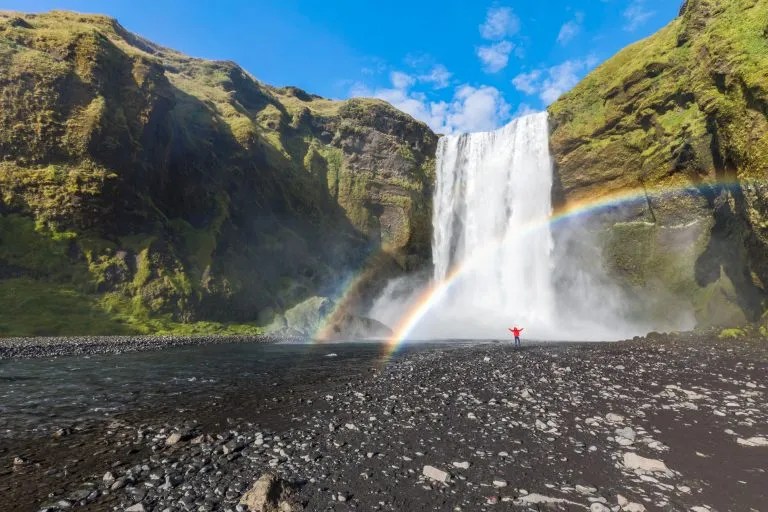
But I have difficultly coming to terms with the very real impact of not just my own carbon footprint, but that of the dozens of children who I encourage to fly on school trips to locations such as Iceland. Facilitating 26 student return plane journeys to Iceland, as I did last month, weighs heavily on my mind. Many of you reading this post will no doubt have also experienced this dilemma.
Premises
Let’s take a step back and look at this issue as part of the bigger picture of flying. My premises for this post are as follows:
Geography teachers are very well-informed people about environmental issues
Being well-informed of such issues, we recognise the existence of, and impacts of, anthropogenic climate change – and that such impacts are overwhelmingly negative for almost all people in almost all parts of the world
We also recognise that climate change is a collective action problem – that is, a situation in which all individuals would be better off from co-operating, but in which there are few incentives for individuals to take individual action
We recognise that as affluent members of an affluent country, we are likely to have a large carbon footprint
We recognise that transport, particularly air transport, is likely to be one of the biggest contributors to our carbon footprint
We recognise that, as teachers, we are role models to our students (and often to those in the wider community), so our decisions about how we act and what we say are likely to have a significant impact on the opinions and behaviours of others
Field trips are an essential part of what we do as geography teachers. We are very likely to organise them, lead them, take part in them, or facilitate them
Whilst essential in their educational role, field trips have an impact on the environment – and generally, those involving trips abroad are more likely to involve flying
So what do we do when we consider opening our students’ eyes to the world by organising field trips which involve flying? Cut out the flights altogether? Always go local?
Let’s return to the podcast for a moment.
Outrage and Optimism
It’s called Outrage and Optimism, and it’s highly recommended listening for geography teachers who want to keep up to date with developments in climate change policy. The three presenters have all been working in international environmental policy making and advocacy for decades: Christiana Figueres is the Costa Rican diplomat who led the negotiations which resulted in the 2015 Paris Agreement, and Paul Dickinson and Tom Rivett-Carnac continue to play active roles in this sphere.
They all fly frequently as part of their work, and they have all taken steps to try to minimise their flying: for several years, Paul only flew for work and not for family holidays, and they all make trips count by combining meetings and rejecting others in favour of remote working. But they all recognise the importance of face-to-face meetings, as well as keeping in touch with family members, and they were all wary of moralising and preaching (as am I!).
They also recognise the range of opinions in the climate change community: in a survey they issued prior to the programme, 21% of the respondents said it was okay to fly, 21% said it wasn’t, and 58% said it was okay to fly in some circumstances. They are under no illusion as to the role of flying in climate change, and the fact that its contribution to emissions is likely to rise owing to growing global prosperity and the decarbonisation of other sectors. They flag up efforts to decarbonise the aviation sector: in keeping with the ‘Optimism’ part of the podcast’s title, they are open to the idea of technological solutions in the mid- to long-term. But they are honest about the limited impact these will have in the next decade or so.
The Figueres Defence
The most powerful contribution to the discussion was by Christiana. She issued a forceful defence of carbon offsetting:
“I have been abundantly public for many years that I am an offset proponent. I think it is important, because I come from a developing country, and I have seen the benefit in developing countries of receiving funding for projects that otherwise would not be funded”
She pointed out that the offset market uses rigorous methodologies. Nevertheless, she recognised that providers of offset schemes are unregulated and there is much uncertainty in the sector. To compensate for this, she implored listeners: “if you’re going to offset, offset abundantly and generously” and “make sure that you have covered and over-covered your emissions, and that you are investing in high quality projects in developing countries who need that investment.”
How might Christiana’s contribution speak to the geography teacher’s dilemma?
Six suggestions for Geography teachers
Returning to the premises at the start of this post, we should be mindful of the carbon footprint of field trips and we should also consider how we might run them in a way which facilitates the discussion of these issues by students and teachers alike. So here are six suggestions for how geography teachers might approach the dilemma of flying and field trips:
Use flights on a field trip when other alternatives are not reasonably available
Fly when the experience warrants it
Organise field trips that involve flying less often than you might be tempted to – perhaps once every two or three years? We now interleave our foreign field trips, which used to take place annually, with one to the excellent Field Studies Centre in Millport, on the Isle of Cumbrae in western Scotland.
Carbon offset your flights, and consider ‘over-offsetting’ – see Christiana’s comments above
Ask tour providers what they are doing about the impact of their flights. When I called three school tour operators a few years ago about this issue, only one had formulated a policy about it: Discover the World Education. So I stopped using our previous tour company and began working with DtWE. More tour companies are developing their sustainability policies, but it is still worth asking questions of them
Involve students, parents, and indeed your senior leadership team, in your deliberations, and take the issues out in the open. For the first time this year, we included a slide on sustainability in the parent’s information presentation, and this began not with reusable cups and paper straws, but with the ‘elephant in the room’ – the flights – and why we were contributing to Discover the World’s ‘Greener Growth’ offset scheme. We are proud that we have paid £20 per student into this scheme: a total of £520
You may well be further down the road in terms of sustainability of your geography field trips than me, or you may have just begun the journey.
You may have already dismissed the idea of offsetting, or you may have embraced it.
You may feel that the geography curriculum – and the acts of its teachers – should be clearly separated from issues of how we ‘act sustainability’.
But whatever your stance, I believe that if you return to the premises I set out at the start of this post, you will agree that the issue of flying is certainly worth paying attention to, and perhaps worth acting upon. I welcome your thoughts.
After several years in gestation, and with the assistance of Elaine Anderson and Richard Bustin, I have distilled my ideas of how teachers may offer students ‘grounds for hope’ for their future and that of the world into an article for the Spring 2024 issue of Teaching Geography journal.
I have been inspired by many people, among them the psychologist Maria Ojala, who argues that fostering ‘constructive hope’ can enhance students’ engagement with issues of sustainable development, and David Hicks, who has written much on the topic of hopeful geography over the past couple of decades.
I take Hicks’ work further by drawing more heavily on global scale examples of ‘social progress’ to improve students’ aware of ‘big picture’ changes. I foreground Max Roser’s ‘three truths’ argument: the world is awful, the world is much better, and the world can be much better (see below):
The article also features resources which can help teachers to keep their understanding of global social trends up to date, including Gapminder, Our World in Data, and Pixels of Progress and in doing so it recognises the legacy of inspirational public health professor Hans Rosling.
A number of teaching resources which could be used by teachers wanting to engage with hopeful geography are featured in the article and as downloads; I have trialled all of them in schools (one example of a student’s future timeline is given as an illustration).
I give the threefold concept of hopeful geography, which can be taken further as the foundations of a hopeful education. I have written about this elsewhere in this blog, although my ideas evolve over time. I advocate for a curriculum which enables our students to do three things:
Evaluate progress
Believe in humanity
Create a sustainable future
Any approach to education should be open to criticism, and hopeful geography is no exception. I acknowledge several concerns, most notably the accusation that it could lead to complacency, and I try to address each one.
As the article went to press, Hannah Ritchie’s book ‘Not the End of the World’ was published, and whilst it too is not exempt from critique, the guiding message of that book chimes with mine: it is helpful to open the possibility to our students that they might be “the first generation to build a sustainable planet” – and as geographers, there is no better opportunity than now to inform and inspire this generation.
My article in the February 2024 edition of Geography Review outlines culture-led regeneration, assesses its impacts, and evaluates the need for regeneration in Bradford. It also outlines plans for Bradford’s year as the UK City of Culture in 2025. I’m proud that the editorial team made it the cover story (see above).
In this article, I differentiate between regeneration structures (the long term conditions necessary for areas to thrive, such as physical and social infrastructure, and policies such as taxation and immigration) and regeneration strategies (which tend to focus on one area for a time-limited period). The UK City of Culture scheme falls into the latter strategy. Culture-led regeneration is an increasingly popular strategy: it refers to attempts to use arts, music, literature, and often sport too, to attract people and investment to an area.
The success of Liverpool’s year as the European Capital of Culture in 2008 encouraged the UK government to launch its own City of Culture competition, the winners of which are shown below:
Year
City
2013
Derry-Londonderry
2017
Kingston-upon-Hull
2021
Coventry
2025
Bradford
Winners of the UK City of Culture Competition
The UK provides cities (or regions) with funding to prepare a bid, and winners receive several million pounds to make their plans into a reality (Bradford will receive at least £3 million).
Plans for Bradford include making the most of the revitalised City Square, Bradford Live arena, the Alhambra and St George’s Hall, and many more venues across the borough. Themes will include ‘City of the World’, ‘Coming of Age’, ‘STEAM powered’ and ‘Welcome Home Sexy!’ – the latter refers to grafitto which visitors to the city could see when they arrived at Bradford Interchange train station (see above).
Critiques of the culture-led regeneration include discussions of the ethics and efficacy of spending money on cultural offerings when social needs may be more acute, and concerns that the laudable aims of culture-led regeneration may have been taken advantage of by big business. Oli Mould’s critique is featured in the article.
The whole world in their hands? Educationalists are considering how they might embrace AI as closely as their students are. (Image source: Adolfo Eliziat)
ChatGPT is here to stay – so how might we embrace it?
Their hands rose tentatively at first.
But the secret was out: some of my students had already come across the artificial intelligence app Chat GPT, and a couple of them were even willing to admit using it to help with their studies (not in my subject, of course!.
If you are a secondary school teacher and you haven’t tried it yet, then I advise you to “wake up and smell the AI”.
Since its launch at the end of last year, educationalists have been wondering about how their practice might be impacted by this free, online, Artificial Intelligence application. For those who aren’t aware of it, it allows you to type in a question and within seconds it produces a tailor-made answer. Several teachers have reflected on how it might help teachers work (more on that later). But how will it affect the tasks that we set our students, and what might the longer-term implications of this technology be?
Sober analysis
The initial frenzy of speculation about ChatGPT has now subsided as teachers and school leaders have embarked on more sober analysis of its implications. This has been assisted by the fact that the ChatGPT application was been overwhelmed by in January and was offline for much of the month. It is currently being eased back into operation so it can cope with users of all shades and stripes (including, yes, numerous students). And the tone among educators has already shifted.
Yes, there has been an acceptance that we will have to move away from setting students recap and past exam paper questions to complete at home. But this should have been the direction of travel for years, thanks to the increased sophistication of online search engines and the common practice of students sharing responses with each other, not only in person, but also via social media.
And yes, the current model of coursework, let alone qualifications which are largely or wholly based on written reports, such as Extended Project Qualifications, will have to be significantly rethought. Examination boards will need to grapple with increased urgency whether they can reform their qualifications, perhaps moving towards intensive ‘in-house’ write-ups of geography and history investigations.
Workarounds and opportunities
But there are several other workarounds, and indeed opportunities, that teachers and schools can employ in the light of ChatGPT. Some involve meeting its challenges and circumventing the risks of plagiarism. These include:
Adopting ‘flipped learning’ more wholeheartedly. Its benefits are already well known, but this might be the time to embrace it. Flipped learning involves asking the students to research, consolidate, and tackle simpler tasks at home, freeing up class time for higher value-added and/or interpersonal tasks such as evaluation, discussion, and decision-making.
Flipped learning frees up classroom time for more active learning opportunities (Image source: Teachers with Apps)
Setting tasks which are bounded by local and up-to-date limits. This is because ChatGPT is, at the moment, fed by data which was online in 2021. For example, these four tasks stump it:
“Write up today’s experiment”
“What three things did you learn from today’s lesson?”
“What were the geopolitical challenges of 2022?”
“To what extent is Ilkley economically inclusive?”
Changing the format:
Holding more discussions – for example, Harkness discussions – and consider setting oral assessments
Trying alternative formats for work, such as sketching, photos, paired work, and videos
Running students’ answers through an AI detection software – the pre-eminent one is Edward Xian’s ‘GPT Zero’, which gives a ‘perplexity score’ – the higher the score, the more likely it is that text has been written by a human; GPT-2 Output Detector is another.In OpenAI (the creators of ChatGPT) also say that they are planning to run a ‘watermarking’ scheme so that AI-generated answers can be flagged up to consumers.
Additionally, as commentators such as Daisy Christodoulou and Evan Dunne have pointed out, we can also use ChatGPT to help us with a variety of our everyday tasks, and to enhance our teaching. We can use it to help us to mark, set quizzes, and write lesson plans and assemblies, and so on.
We can also encourage students to critique answers generated by ChatGPT, and discuss how they might be improved. Might we even see a return to examination boards adding the word ‘flair’ to their mark schemes for longer answers? This is something that a chatbot cannot easily demonstrate – yet!
The human side of education
Image from the Eco-Capabilities project (Image source: Nicola Walshe, via EcoCapabilities)
Let’s take a step back for a moment, though, and look at how the wider educational landscape may be shaped by this app, and by its later iterations – not to mention the products of competitors like Google’s DeepMind.
Like it or not, AI will probably end up taking some of the control away from how we help students encounter knowledge about the world. In response, educators should take the opportunity to develop – and shout about – the human side of what we do. What a world of opportunity this could open up! We could develop into an army of well-respected teacher-facilitators, ushering in the next generation of critical thinkers.
We could also open curriculum breathing space, freeing up time from unrelenting knowledge transmission, and directing our energies into developing more rounded young people. They could be given more time to pursue the arts, sports, and outdoor learning, and to develop ‘eco-capabilities’ to reconnect with nature.
Let’s be bold as we contemplate how we might harness ChatGPT’s powers, not only to make teaching more efficient and relevant for our students, but also how we might work towards a more humane, caring, and sustainable future for everyone.
This post was developed alongside a presentation given to staff at Bradford Grammar School on 18 January 2023.
What themes might reinvigorate the global dimension of geographical education?
How should geographical education engage with visions of the future?
These are the two concerns of this post, and they are intertwined.
The post mainly concerns geographical education, but the discipline is necessarily implicated. It is meant as a discussion generator rather than as an academic article, so please excuse any clangers and unattributed notions!
The Geography of It All
The immediate trigger for this post is ‘The Geography of It All’, a recent article by David Lambert (2021), which poses the central question of “[W]hat does geographical study bring to the table, especially in our deliberations with young people about contemporary predicaments and existential challenges[?]”.
It is an accessible and thought-provoking piece which is open about geography’s predicament, warts and all. So, for example, Lambert flags up geography’s physical-human divide, its involvement in ‘competing’ with history for students, and its complexity, which threatens to overwhelm the integrity of the discipline. But he is insistent in promoting the value of geography – not just for students, but for the future of planet earth. His concluding paragraph is worth quoting in full:
“An appropriate educational response to the human epoch needs to value geographical thinking: thinking that does not put human beings above (or even separate from) nature; that puts locales and nations into their global context; and which always seeks to understand interconnections. I believe reformed school geography, which seeks to enhance children and young people’s capabilities with regard to thinking about society and nature relationships and environmental futures, represents a profound educational response to the challenges of the human epoch.”
Lambert therefore sees global futures as integral to the future of geography. I concur, and I offer some considerations that might inform the global dimension of ‘a reformed school geography’.
The symbiosis of History and Geography
Lambert notes how philosophers of history are increasingly recognising the role of earth systems in the story of humankind. If the role of the ‘non-human’ is indeed becoming more salient in the discipline of history, then this raises the prospect that we might see this feed more explicitly into the school history curriculum in the years to come. We must hope that this will see an appreciation of the importance of human/non-human interactions and planetary limits rather than a re-emergence of environmental determinism.
Just as history is coming to terms with the environment, I argue that geography should be more comfortable with temporality. In a presentation to the recent GA Geography Teacher Educators Conference[1], I showed images of four two-page spreads from a current A Level textbook on the theme of human development. There were a handful of maps, a smattering of tables and photographs, but no graphs showing change over time – and little recognition of trends in the text either. This may be an extreme example, but could it be symptomatic of an underplaying of trends in some parts of the geography curriculum, particularly in global development? Might this go some way to explaining why many students are so surprised when they are confronted with evidence for long-term improvements in a wide range of indicators of social flourishing, as presented by resources from the Gapminder Institute, Our World in Data, and so on?
Lifting our eyes up
Alongside a consideration of how much attention geographers could spend on long-term trends, it is timely to consider to who we claim to be speaking on behalf of. Indeed, although Lambert’s article chimes with my thoughts on the subject’s global dimension, his comment that “we are browbeaten about the end of progress (when we can no longer assume our children will have ‘better’ lives than their parents)” deserves closer attention. His use of ‘we’ and ‘our children’ appears to be made from the view of someone in the global north – and yes, from that standpoint, there has arguably been a narrowing of horizons, a questioning of progress, and a growing sense of unease, driven by inequality and widespread economic stagnation.
However, taking into account a broad sweep of socio-economic measures from a range of well-respected IGOs, and notwithstanding stubborn levels of inequality within countries, living conditions for most people in the global south have seen continual improvements over at least the past seventy years (Roser, 2018; Rosling et al, 2018), meaning that, in most respects, many global citizens are living ‘better lives’ than their parents, and many will expect their offspring to live ‘better lives’ in their turn.
Figure 1: The world is much better. The world is awful. The world can be much better (Roser, 2018)
Drawing students’ attention to these achievements (see, for example, Alcock, 2019a, 2019b; Standish, 2020), should not be seen as being dismissive of remaining problems, or as being ignorant of the huge challenges of the Anthropocene. As Max Roser – the founder of Our World in Data – has written, “The world is much better. The world is awful. The world can be much better. All three statements are true” (Roser, 2018; see Figure 1). There is indeed a great opportunity for a rich and far-reaching debate to be had, not only amongst geography educators, but also between students, on the theme of ‘progress’. This would draw on commentators who have responded critically to proponents of an ‘optimistic’ or, as Rosling would have it, a ‘possibilistic’ worldview (see, for example, Hickel, 2017; Paulsen, 2019a, 2019b; Aguilera, 2020).
A reformed school geography, I argue, should enable students to develop a more accurate and balanced evaluation of humanity’s achievements and failures over a prolonged period, and at a global scale. Such a worldview would not be uncritical of economic and social failings or of environmental crises. Instead, it would contextualise them. It would not underplay young people’s anxieties about the future. But it would embolden them to develop a sense of hope, as they would be able to draw confidence from previous successes – such as victories in human rights, reductions in child mortality, and increases in renewable energy supplies – with which to face the future. This balanced evaluation would also assist them – and us, as teachers – to pursue our shared geographical journey to explore the challenges of the Anthropocene.
My other reflections on Lambert’s post come under three broad themes.
Three global themes
With the above comments in mind, and in response to Lambert’s provocation, what might the global element of a ‘reformed school geography’ look like? I offer three very broad approaches. These are rough and ready, incomplete, overlapping, and they piggyback on the ideas of many others. Indeed, many elements are already taking place in classrooms – and remote learning environments – across the country! My main aim is to stimulate a reaction, to help geography stay relevant, engaging and attractive, but moreover, so that it is able to be more responsive to the challenges facing the human and non-human world.
Big Picture Geographies
Big Picture Geography would entail an increased awareness of significant historical trends in ‘human’ geography (using data visualisations such as those on Our World in Data), accompanied by a focus on graphicacy skills.
It would also harness the power of ‘big picture’ narratives. In a comment below Lambert’s piece, the historian Andreas Koerber identifies a new wave of large-scale popular historiography which he calls ‘Big History’ but whose contents are often deeply geographical (for example, Frankopan, 2015 and Diamond, 2011). This appetite for popular narratives which explore long-term changes over space exposes a vein of curiosity which geographers should leap at the opportunity to tap into. Geography teachers and students should take care not to be ‘prisoners of geography’ and look outside of our traditional literary domains.
Big Picture Geography should be informed by a decolonised approach to the subject: it should involve a wider range of perspectives, it should heed more voices, and it should acknowledge and problematise the long history of shifting power relationships.
Co-operative Geographies
For too long, Garrett Hardin’s ‘Tragedy of the Commons’ (1968) has been the go-to resource use theory for many geography teachers, myself included. However, although it assumes innocent actors combining to cause large-scale problems, in its application, it heightens misanthropic prejudices and a pessimistic view of human co-operation. It is time for a tilt towards co-operative geographies. These would give due recognition to evidence showing the fundamental decency and collective mindedness of most humans. Giving more saliency to Elinor Ostrom’s theories of small-scale co-operative management of common resources would not only be closer to what happens ‘on the ground’ in many cases, but it would restore some much-needed belief in humanity. Rutger Bregman’s Humankind (2020) is another weapon in the geographer’s armoury against cynicism: he draws on a wide range of historical evidence to argue that believing in human kindness and altruism can change how we think and act.
An examination of different scales of co-operation would be a great geographical project, and a way to build a conceptual bridge from the local to the global. It could draw parallels between small-scale community initiatives such as Friends groups and Green Flag projects, regional and national instances of altruistically pulling together (as shown by the high levels of adherence to social distancing rules in the Covid-19 pandemic), and international and global examples of co-operation, such as the UN’s Sustainable Development Goals.
As Elise Boulding pointed out in 1988, IGOs and NGOs may be interpreted as aspects of a co-operative global civic culture which fosters ideals of global interdependence, sustainable development and peace – but how often do we refer to them as such? And how have geography teachers framed largely successful co-operative endeavours such as the European Union? Generations of students grew up thinking of the EU as creators of milk lakes and butter mountains and pesky imposers of fishing quotas, rather than as engines for peace and creators of social democratic norms. (Did Boris Johnson bribe David Waugh?)
A more realistic, historical, and evidence-based awareness of how humans pull together, adapt, and respond to resource challenges would also enrich secondary school geography. A move away from the discredited theories of Thomas Malthus to a more nuanced examination of the ideas of a range of thinkers, including
Ester Boserup, Kate Raworth and Ruth DeFries (see, for example, DeFries, 2014) would reveal different takes on the contentious issue of population/resource management. This might then soothe pupils’ fears of a ‘population explosion’ (which, according to one KS3 Geography video on the otherwise commendable Oak Academy, is still happening!) and instead open up a new sense of optimism for engaging with the future.
Planetary Futures
Reinvigorating the ‘futures dimension’ is vital in reformed secondary school geography. The groundwork for this has been laid down by David Hicks and others since the 1990s. The theme of the 2007 GA Conference was Future Geographies, and there is a significant bank of resources and skilled practitioners that could be drawn upon from the past thirty years or so. Francis Hutchinson (1996) is also a source of inspiration for geographers who are keen to get a handle on how to teach a futures-orientated curriculum. An intriguing and agenda-setting article by Hoffman et al (2021), based on action research, found that “a futuring approach to education… contributes to an enhanced sense of agency among students in dealing with wicked problems”.
Sitting squarely alongside futures education, but also drawing from the ideas of ‘Big Picture’ and ‘Co-operative’ geographies, a reinvigorated and evidentially grounded ‘geography of hope’ should surely play a role in the education of future geographers: this would help students to evaluate progress, believe in humanity, and then, using these insights, help them to create a better world[2].
Climate change deserves a special place in the curriculum. As the ultimate global ‘wicked problem’ – and one which is not going away any time soon, it deserves a permanent, significant, and guaranteed place at the table, and it should be repeatedly visited in the classroom. The wording in the National Curriculum is not emphatic enough. Climate change is a touchstone environmental issue and one which the public view as being inherently geographical. It also allows for the development a panoply of hard and soft skills, as well as providing an opportunity to feed into ‘Big Picture’ and ‘Co-operative’ geographies. Two of the most pressing needs are firstly for students to be able to have the skills to navigate the debate about ‘who is to blame’ for climate change, and secondly to appreciate the relative impact that different strategies might have on overcoming this challenge (see, for example, Project Drawdown): what use is recycling and turning lights off, if steel and concrete production continue unhindered, and animal products remain a mainstay of so many diets?
Planetary futures would also provide a suitable home for Late-covid and Post-covid geographies. The resource bank developed by Alan Parkinson (2020) is a treasure trove for educators which could be used to help conceive of a post-covid world. Applying some of the insights to other infectious diseases would help to bring up discussions in health geography which until now may, for many of our students, have been muted owing largely to the fact that diseases have mostly occurred ‘in other places’.
Bringing young people in
Lambert is passionate about developing children and young people’s capabilities; I agree, and they deserve a central and active role in the future of school geography, both as agents in the reformulation of the curriculum, and as citizens of the world it – and they – will help to shape. If we are bold enough to reform the way we approach the global dimension of school geography, then we should involve young people in our journey. Exactly how this could be done is beyond the scope of this piece!
As the world moves on, so must geography. If we accept that the Anthropocene is indeed a ‘game-changer’ (as Lambert refers to it on a comment in the thread below his article), we need to continue with the pivot to the global and take the futures dimension seriously too.
I welcome feedback on these ideas.
David
References
Aguilera, R. (2020) The Glass Half-Empty – Debunking the Myth of Progress in the Twenty-First Century. London: Repeater





 alcockblog
