
Categories
Uncategorized

Hope across the curriculum

The Strange Case of Dr Jekyll and Mr Hyde book cover (source)

What should be the headline of the last 125 years?

When I ask this question of my students, I receive a variety of responses, ranging from ‘wars’ and ‘climate change’ to ‘the internet’ and ‘globalisation’.

I never hear ‘doubling of global life expectancy’, ‘collapsing infant mortality rates’ or ‘far fewer deaths from famine and disasters’.

It’s not that the previous answers are wrong, it’s just that without an awareness of some of humanity’s achievements, it is difficult to have a wide-ranging discussion about the ‘big picture’ of global change.

I must sound like a broken record in my call for there to be more ‘scope for hope’ in the geography curriculum.  You can read more in my blog about my contention that students often leave their studies unaware of developments such as those mentioned above.  The current programme of study at key stage 3 is not only notoriously muted on climate change, but its only nod to the profoundly life-changing (albeit unequal) advances in human flourishing is to require the understanding of “the key processes in… human geography relating to… international development”.

Hope beyond Geography

But Geography does not exist alone – it is, of course, part of an educational ecosystem in which students absorb and negotiate messages about the world from their other subjects, and from whole-school and extra-curricular activities.

Recent discourse in the press has prompted me to reflect on what role other subjects might play in the development of the worldview of our students.  This is crucial for educators to consider, as our students need to be confident in playing their part in creating a sustainable and flourishing society and environment for their and subsequent generations.

English – cynicism over hope?

Author Caitlin Moran suggested in The Times in July that the “dry and depressing” GCSE reading list is part of the reason why teen reading rates are plummeting: “I’m a 51-year old author of nine books and even I wouldn’t want to spend a long, hot summer going line by line through Dr Jekyll and Mr Hyde”.

The poet Hollie McNish equally did not hold back on her stance in The Guardian: “After spending many evenings this spring testing my daughter on her GCSE English Literature quotes, I felt ready to vomit. Three set texts: Lord of the Flies, Macbeth and The Strange Case of Dr Jekyll and Mr Hyde. Shared themes of blood, death, murder, violence, the evil of boys and men. Then, if you’re tired of revising prose, a little war poetry for a breather. Lovely. More death.”

Moran went on to ask curriculum developers to pick “something loving, anything funny; just one book teenagers could smile at, laugh with even”.  In the letters page a week later, Rachel Stott agreed, asking “Is this corpse-rich literary diet really the healthiest we can offer our notoriously anxious and doom-laden youth?”.  The premise behind The Lord of the Flies – that left to their own devices, boys will descend into chaos – has even been thrown into question by the real life story of boys who were shipwrecked on a desert island in 1965, which Rutger Bregman uses as an illustration of the fundamental kindness of most of humanity.  Is our choice of set texts teaching our students to become not only critical about the world, but cynical?

History – narrow scope for hope?

And what about the History curriculum?  Whilst the current programme of study requires students at key stage 3 to know and understand the history of the British Isles “as a coherent, chronological narrative”,  it does not require any kind of “coherent, chronological narrative” of broader world history, merely requiring students to understand about the “achievements and follies of mankind”.

Examples of social progress are optional at GCSE – one laudable example being Edexcel’s GCSE History’s unit Medicine in Britain, c.1250 to the present day – and as far as I can find, there appears to be no chance for GCSE students to evaluate global progress (or otherwise) in medicine or any other aspect of human flourishing.

PSHE – skills for life, or risk fatigue?

It could be argued that developing a worldview which at least gives the scope for hope is beyond remit of these subjects.  Cross-curricular ‘big picture’ themes such as human flourishing and the nurturing of critical and rounded worldviews may need to be taken on by schools outside of traditional disciplinary silos.  One alternative home for such themes may be Personal, Social, Health and Economic (PSHE) Education, which, as part of its aims, seeks to teach “knowledge and skills that will equip them for life”, including managing “the increasing influence of peers and the media”.

I have indeed taken up the opportunity in my teaching of PSHE to consider how the media and other influences can affect our world views and can cultivate a pessimistic stance towards the wider world.  I also believe that there is a danger of ‘risk fatigue’ in PSHE discourse: faced by a barrage of threats in the realms of sex, drugs and crime, young people may either shut down and disengage, or they will not have the scope to put the risks in the context of wider societal trends, many of which are positive.

And so, as the curriculum review process moves on, whatever role we occupy, we should all keep in mind the importance of offering grounds for hope for the future to our students.

I welcome responses to my somewhat provocative arguments from those with other experiences and standpoints.
Categories
Geography Teaching and Learning

Teaching conferences – why and how?

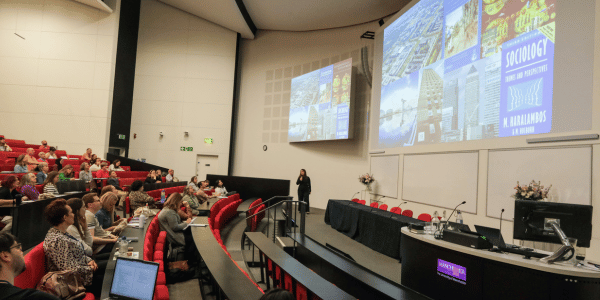
Just one of the dozens of sessions at the 2024 Geographical Association Conference (source: GA)

You’ve been teaching for a while. You’ve got the textbooks, the notes, the resources, and you have a good team around you at school. And of course you’ve got the internet. So why add to life’s complexities and expenses and go to conferences as well? And what should you do when you do attend?

I attended the GA Conference for a couple of years as a new teacher, but then fell out of the habit, only to return in recent years, with a renewed zeal about engaging in these hubs of geographical ideas and collegiality, and I present most years, on a variety of topics.

I hope that by sharing some thoughts about conferences I might inspire you to attend and to think about how you can overcome some barriers which might prevent you from doing so. In this brief guide, I cover the reasons for going, and I have put together some ideas for what you might want to consider before, during, and after attending them.

Why go?

Why should you go to a teaching or academic conference? As a teacher and a part-time postgraduate student, I can see the value of both types, and whilst some of the reasons for attending one type of conference will be different to those for attending the other, there is considerable overlap between the two, and this section attempts to cover both.

– To refresh your thinking, curriculum, and pedagogy. Conferences allow you to keep up to date with what’s happening outside of your ‘bubble’, whether that is your school, your exam board, your circle of colleagues, friends and influencers, or just your geographical milieu.

– To expose your ideas to others. This will especially be true if you present a talk or a workshop, but it also applies to question-and-answer sessions and informal discussions.

– To network. I have often shied away from this term, as it seems very transactional, but as well as being a way to look for work and new projects, networking also serves to keep you informed and refreshed in your current and future roles and activities. You may also be able to pass on opportunities or advice to other attendees, whatever your or their role might be.

– To keep your subject and/or discipline alive, fresh, and thriving. Ideas die in a vacuum, and so do subjects. However small, your attendance and involvement in conferences will help to maintain and enhance the viability and relevance of the subject in a challenging school and academic environment.

You will, of course, have other reasons for attending, and one of mine is to take a break from my usual routines and to regain the ‘travelling bug’. We like to preach about students learning ‘in the field’, and I believe that we should follow suit: getting out and about, and interacting with different people and places, on your way to, and at, conferences should help you to develop as a geographer.

What to do beforehand

– Scope out sources of funding for your trip. These might be from your school or university, or you may be able to source sponsorship from a publisher if you have been involved in examining or writing. Attending the GA Conference has been called ‘the best value CPD’ in the subject, as you can drop in to several sessions for a similar price as a one-day course taken by a single organisation or led by a single speaker.

– Book tickets, transport, and accommodation early, or at least scope out the options. This will help to keep costs down. Consider staying at free (family or friends) or very low-cost accommodation: you may not have stayed at hostels since your youth, but they offer convivial, compact places to stay. Some offer ‘pods’ which allow you to sleep in privacy.

– Consider other ways to keep costs down. You don’t need to bring your own outsized plate to an all-you-can-eat buffet, but you can make full use of the inclusive conference food and drink opportunities, walk or use cheap public transport, and be willing to shorten your stay.

– Try to be sustainable. In the hierarchy of environmental impacts, travel will usually be your biggest impact, so look into train, bus, ferry, and active travel where possible, and share private transport where you can. I travelled to the IGU Conference in Dublin by train, ferry and bus, and on each mode I was rewarded by chances to think, sleep, read, and write. I left the last session at noon, grabbed a conference lunch, then travelled by bus, foot, ferry, and three trains to my home in a Leeds suburb in just over nine hours. Food and other consumption and waste-related habits will also be a consideration. But you can be reassured that, as a geographer, you are likely to be playing a part in sharing environmentally friendly attitudes and behaviours in your working life anyway. Other ethical considerations will also no doubt enter your decision-making processes, and it’d be good to share these with the conference organisers in their post-conference surveys, or well in advance of the next one.

– Don’t be afraid to apply to talk at conferences! You might want to start off by doing this as part of a duo or a small team or a short contribution to a ‘Teach Meet’. In recent years, both the Information and Communication Technology (ICT) and the Geography Education Research (GER) Special Interest Groups have run sessions where they have invited participants to speak for a few minutes on a practical IT idea or some potted research findings at the GA Conference, and a handful of Irish researchers delivered five-minute ‘lightening’ talks at the IGU Conference in Dublin.

– Contact the conference organisers in advance with queries. You may have some justifiable anxieties around inclusion, and conference organisers should do their best to accommodate and welcome a diverse group of delegates. Groups such as the Decolonising Geography collective are also valuable and friendly sources of support and advice in this regard.

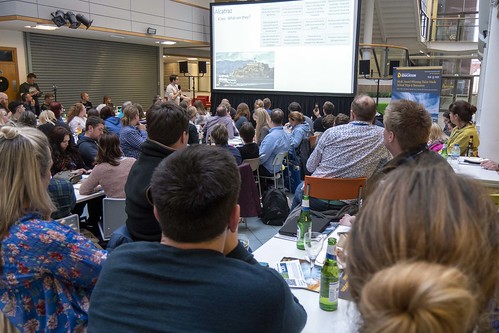
GA Teachmeet, 2018 (source: GA)
What to do during the conference

This is, of course, totally up to you, and it will depend on your reasons for attending. But you might want to consider these points:

– Approach people – and appreciate that everyone else will also be facing similar challenges to you in terms of remembering names and faces. Don’t forget to wear your name tag and to look at other delegates’ tags too – they’ll be looking at yours!

– Interact with presenters – this could be by asking a question, or by stopping afterwards to talk to them. I find these easier to do than approaching people ‘cold’ as mentioned in the previous bullet point. Most presenters will welcome your interest in their ideas.

– When choosing which sessions to attend, try to mix your usual areas of interest with others. For example, at the GA Conference, you might find classroom and curriculum-building sessions the most immediately useful, but subject knowledge updates will help to reinvigorate your passion for the subject, as well as come in useful the next time you teach the topic covered. They might also promote new ways of thinking – for example, at the IGU conference, amongst the sessions on Geographical Education, I attended one on African ‘development’ and one on political Geography. At the latter, I was reminded of the role that climate scepticism plays in several far right, disruptive, and some other populist movements, and I carried that thought over to the ensuing session on climate change education, where I considered how educators might succeed in fostering pro-environmental attitudes amongst young people that they may carry into their adulthood, when they may feel more empowered to vote and to more amenable to pro-environment policies when governments enact them.

– Make notes during presentations. How you react during and after sessions is personal, but I find that making hand-written notes helps me to process and prioritise what is taking place in sessions. Other attendees may type up notes, and others will just attend thoughtfully. Be respectful though. Whilst a few delegates attending to emails and messages in a presentation is to be expected, it can be disheartening to speak to a room where such behaviour is commonplace. This behaviour can also be distracting to other attendees too. I have twice seen the same delegate watch cycling races on his full laptop screen – and on one of these occasions he was even chairing the session and sat on the front row!

– Miss some sessions! You can’t do everything, so you will have to be resigned to missing some sessions which clash. You may even decide to take a break from attending any sessions – or slipping out midway if you are about the speak at a session yourself (although see the previous point – this should be done quietly and politely).

– Attend some events that escape the confines of a lecture theatre or classroom! Some field trips at the GA Conference only last forty minutes; others may take over an hour – and some at the IGU conference took up half a day.

– Engage with the social calendar. This could be an informal ‘lunch with…’, an evening meal, a guided stroll, a pub crawl, or a hybrid of these events. This way you will get to know people a bit better and even explore ways you might work with them in the future. Good friendships often begin or are strengthened by such events too.

– Take some time to decompress. This could be going for a walk, run, or whatever you do to relax. If you think you’ll find it hard to do this, then why not combine it with your transport needs – I walked several miles to and from the conference, bus stops, and the ferry port in the recent IGU Conference, and over a decade ago I popped out of the GA Conference in central Manchester to do an urban orienteering event!

After the conference

Follow up on leads, write down your main take-aways, and you may also want to consider writing about your presentations, or your conference experiences, either for Teaching Geography or Primary Geography, or more informally via blogs (including, but not confined to, the GA blog).

If an organisation funded you, they may want a report or a presentation, and although this may seem to be a drag, you can tell yourself that such a task will help in your self-reflection, professional development, and intellectual stimulation.

To find out more, talk to colleagues and friends who have been to conferences before, contact the organisers, and feel free to ask members of the GA – including the author of this piece!

Go for it!

David is a member of the Geographical Association’s GERSIG (Geography Education Research Special Interest Group); this post was originally published in the Geographical Association’s Blog: https://ga-blog.org/2024/12/16/geography-conferences-why-and-how/